
Top 5 Prop Firms with No Time Limits
Proprietary trading firms provide traders with access to capital through a funded account, allowing them to trade larger positions without risking their own money. In exchange, profits are split with the firm.
Traditionally, most prop firms impose deadlines and minimum trading days during evaluations, which often pressures traders into suboptimal trades and unnecessary trades.
By contrast, prop firms with no time limits let you complete evaluations at your own pace, supporting your trading style without the stress of a ticking clock.
In this guide, you’ll discover five top prop firms offering no-time-limit challenges in 2025.
Key Takeaway
Prop trading firms with no time limits allow traders to complete evaluation phases without deadlines or minimum trading day requirements. This approach gives traders the freedom to:
- Trade at their own pace
- Focus on high-quality setups instead of quantity
- Reduce stress and improve decision-making
- Support any trading style, from scalping to swing trading
- Build consistency and confidence without time pressure
Choosing a prop firm with no time limit means you can qualify for funding when you are ready, not when the clock says so.
Best Prop Firms with No Time Limits in 2025
Below, we’ve reviewed five of the best prop firms offering no-time-limit evaluations in 2025. Each provides distinct features, from funded trading accounts and multiple account sizes to generous profit splits and platforms designed to support a variety of trading styles.
1. Top One Trader
Top One Trader is a US-based proprietary trading firm launched in 2023. It has quickly gained attention among retail traders thanks to its trader-friendly rules, fast payouts, and flexible evaluation models. One of its most powerful features is the complete removal of time pressure during the evaluation process.
No Time Limits or Minimum Trading Days
There is no time limit to pass the challenge. Whether it takes you one week or several months, you are free to trade at your own pace and wait for high-quality setups. This removes the stress of racing against a deadline and helps traders stay focused on making sound decisions.
Even more importantly, there is no minimum trading day requirement. Unlike firms that require a certain number of active or profitable trading days before you can pass the evaluation, Top One Trader lets you qualify as soon as you reach the profit target and follow the risk rules.
You could, in theory, pass in just one profitable day if your setup meets the criteria. This flexibility is ideal for swing traders and those who trade selectively.
To keep your account active, the only rule is that you must place at least one trade every 30 days. Beyond that, you are in control.
Account Options and Models
Top One Trader offers account sizes from $5,000 to $200,000, with scaling plans that can grow your account up to $5 million. It supports One Step, Two Step, and Instant Funding models, all without deadlines or forced activity.
Markets and Platforms
Traders can access forex, indices, commodities, and crypto on platforms like cTrader, MatchTrader, TradeLocker, and full TradingView integration. With spreads starting at zero and commissions as low as $0 to $2.50 per lot, traders benefit from cost-efficient execution.
Reputation
The firm processes payouts in under two hours, with profit splits up to 90 percent. Support is available 24 hours a day, often responding within a minute. With strong reviews on Trustpilot (4.5 out of 5) and Prop Firm Match (4.7 out of 5), Top One Trader stands out as a trusted and flexible funding option for traders who want freedom, not pressure.
Ready to Get Funded Without Deadlines?
Top One Trader offers flexible accounts, realistic profit targets, and no time limit to complete your challenge. Use your own trading strategies, access multiple trading instruments, and benefit from fast payouts completed in as little as 1 hour and 16 minutes.
Start your evaluation today and get funded on your terms!
2. FTMO
FTMO, established in 2015, remains one of the most reputable names in the trading platform industry. Known for its structured two phase evaluation and professional standards, it has built a strong reputation through transparency, timely payouts, and reliable trader support.
No Time Limits, Balanced Structure
As of 2025, FTMO has officially removed all time limits from its evaluation process. Traders now have unlimited days to complete both the Challenge and Verification phases. This updated model reflects a broader shift in the prop trading industry, allowing participants to focus on patience, precision, and well-managed trading strategies without racing against the clock.
Minimum Trading Days
However, FTMO still enforces a minimum of four trading days per phase, requiring traders to place at least one trade on four separate days. These do not need to be consecutive, and there is no rule around daily profit.
Account Options and Models
With account sizes ranging from 10,000 dollars to 200,000 dollars, scalable up to 2 million, FTMO supports both trading capital growth and trader discipline, making it a smart fit for those who want performance driven structure without deadline stress.
3. FXIFY
FXIFY is a forward-thinking prop firm that blends tech innovation with funding flexibility.
Time Limits and Trading Days
As of 2025, FXIFY offers evaluation programs with no time limits, allowing traders to progress entirely at their own pace. However, each phase requires a minimum of five trading days, meaning traders must place at least one trade on five different days to qualify.
Account Options and Models
The firm provides both standard and instant funding options. Account sizes range from $10,000 to $250,000, with scaling opportunities based on consistent profitability. Profit splits go up to 90 percent, and supported platforms include MT4, MT5, and FXIFY’s web-based platform with built-in analytics. With no penalties for inactivity, FXIFY supports traders who prefer a selective, strategy-driven approach.
4. The5ers
The5ers is a pioneer in funded trading programs, offering multiple paths including Bootcamp, High-Stakes, and Hyper Growth.
Time Limits and Trading Days
All programs come with no time limits, giving traders full control over their pace.
In the Bootcamp and High-Stakes evaluations, traders must complete a minimum of three profitable trading days per phase. These do not have to be consecutive. In contrast, the Hyper Growth program has no minimum trading or profitable day requirement, allowing traders to pass in just one high-quality trade.
Account Options and Models
Account sizes range from $5,000 to over $400,000, with scaling plans reaching up to $4 million. Profit splits vary between 50 and 100 percent, depending on the program and trader performance. Platforms include MT5 and The5ers’ custom interface with advanced analytics tools. The firm is ideal for traders seeking freedom, structure, and long-term growth.
5. FX2 Funding
FX2 Funding is known for its simplicity, fast processing, and trader-first model.
Time Limits and Trading Days
As of 2025, all evaluation accounts come with no time limits, and there are no minimum trading or profitable day requirements. Traders can pass the evaluation at their own pace, even with a small number of high-quality trades.
Account Options and Models
FX2 offers both single-phase and instant funding models. Account sizes go up to $300,000, with profit splits up to 90 percent. Supported platforms include MT5 and cTrader, both offering fast execution and reliability. FX2 also provides educational content, Discord community access, and consistent biweekly payouts, making it a solid choice for serious traders.
Key Criteria for Selecting the Best Prop Firm
Choosing the right prop firm goes beyond profit splits or flashy ads. If you’re looking for a firm with no time limit, it’s important to focus on practical criteria that impact your daily trading and long-term success. Here’s what to consider before committing:
| Criteria | What to Look For | Why It Matters |
| Time Flexibility & Trading Days | No deadline to pass the evaluation and minimal or no minimum trading days | Let’s you trade at your own pace and focus on quality setups |
| Fair Evaluation Rules | Clear challenge structure, realistic profit targets, and transparent risk rules | Ensures you know what’s required and can pass without hidden conditions |
| Profit Potential & Scaling | At least 80% profit split and scaling plans tied to performance | Rewards consistent results and allows long-term growth |
| Cost & Trading Conditions | Reasonable fees, low spreads (0–2 pips), and low commissions ($0–$3 per lot) | Keeps costs low and preserves your edge, especially for active traders |
| Platform & Market Access | Access to modern platforms and multiple asset classes | Supports different strategies across forex, indices, crypto, and more |
| Reputation & Payout Reliability | Positive trader reviews and proven payout speed | Builds trust and ensures you’ll get paid promptly and fairly |
| Support & Strategy Freedom | Responsive support, educational tools, and no restrictions on trading style | Empowers both new and experienced traders to grow on their own terms |
By focusing on these key factors like time flexibility, fair rules, trading conditions, and platform access, you can find a prop firm that truly supports your strategy and growth. The best firms offer more than capital; they give you the freedom and structure to trade your way.
Benefits of Choosing a No Time Limit Prop Firm
Here are some of the main advantages of trading with a no time limit prop firm:
No Deadline Means Better Decisions
Without the pressure of a ticking clock, you can trade with more clarity and confidence. A no time limit evaluation gives you the space to refine your strategy, wait for clean setups, and take trades only when conditions truly match your edge.
Supports All Trading Styles
Whether you’re a swing trader, position trader, or prefer short-term setups, no deadlines let you trade in a way that fits your strategy. For example, swing traders often take fewer trades and need patience. With unlimited time, you can pass the evaluation without compromising your approach.
Encourages Smarter Risk Management
More time means more discipline. You can risk smaller percentages per trade, like 0.2% to 0.5%, without feeling rushed. This helps you avoid impulsive trades, stick to your risk management rules, and improve your long-term consistency.
Ideal for New and Experienced Traders
For seasoned traders, this model rewards quality over quantity. For newer traders, it’s a safer environment to learn, test ideas, and build confidence without worrying about arbitrary deadlines.
Focus on Results, Not the Clock
When time pressure disappears, you can concentrate on what really matters: smart decisions, steady progress, and sustainable performance. No more feeling obligated to trade daily—just intentional trading that matches your natural rhythm.

Final Thoughts
In the world of prop trading firms, time freedom is quickly becoming a key differentiator. Firms that offer no time limit evaluations provide traders with a more realistic path to success, especially for those who prioritise quality trades over high frequency.
Whether you’re using a high precision strategy or building experience through a demo account, the right firm should support your growth, not rush it. With the rise of flexible models, the best prop firms are showing that smart rules and scalable capital do not need to come with pressure.
Take Your Time, Trade Your Way
Top One Trader is built for traders seeking flexibility. With no time pressure and full access to demo accounts, trading capital, and a supportive platform, it’s one of the best prop trading firms for long-term growth.
Start your journey today and trade without limits!
Prop Trading vs Hedge Fund: What Traders and investors Must Know
In the rapidly evolving world of finance, two powerful models dominate the active trading landscape: proprietary trading firms and hedge funds. They both focus on turning market moves into profits, but how they do it couldn’t be more different.
Whether you are an ambitious trader seeking funding or an investor exploring active portfolio management, it is essential to understand how each model operates and which one aligns with your goals.
In this guide, we will break down the structure, strategy, risk, and career potential of prop trading versus hedge funds so you can make an informed move in the trading world.
Key Takeaway:
- Proprietary Trading firms (prop firms) back skilled retail traders who demonstrate consistent profitability and sound risk management. These traders use the firm’s capital, not their own, and earn a share of the profits based on performance.
- Hedge funds manage large pools of capital from accredited or institutional investors. They have access to extensive resources, including research teams, risk analysts, and advanced infrastructure, which allows them to pursue complex investment strategies across global markets.
Key Differences Between Prop Trading and Hedge Funds
While both models aim to generate profits from the financial markets, proprietary trading and hedge funds differ significantly in how they operate, fund trades, manage risk, and serve their stakeholders. Here’s a streamlined comparison:
| Aspect | Prop Firms | Hedge Funds |
| Capital Source | Use firm capital to fund traders | Pool capital from external investors such as institutional investors, banks, family offices, and high-net-worth individuals (HNWIs) |
| Client Relationship | Do not manage client portfolios; work directly with independent traders | Serve institutional investors, pension funds, banks, and other financial entities |
| Compensation | Traders earn based on profit splits, typically ranging from 40% to 90% | Managers earn a management fee (e.g., 2%) and a performance fee (typically 20% of profits) |
| Regulation | Lightly regulated, since they do not manage third-party funds | Heavily regulated under laws such as the Investment Advisers Act, with mandatory SEC filings and AML/KYC compliance |
| Trading Strategies | Focus on short- and intermediate-term strategies using technical and fundamental analysis | Employ multi-strategy models including long/short equity, macro, event-driven, quantitative, and arbitrage |
| Accountability | Traders take responsibility for their funded accounts by following rules set by the prop firm | Fund managers are responsible for investor performance, risk management, and compliance with regulatory standards |
How Prop Trading Works
Prop trading firms evaluate traders through challenges or instant funding models, then provide capital to those who meet their criteria. Traders follow strict rules and earn a share of the profits based on consistent, disciplined performance.
Evaluation Through Challenges
Most prop trading firms use challenges to evaluate and find skilled traders. These challenges require traders to reach specific profit targets while following strict risk management rules, such as daily and maximum drawdowns. Depending on the firm, the process may involve one to three steps.
Some firms also offer instant funding accounts without a challenge. These usually involve higher fees and stricter conditions, particularly around drawdowns.

Trading Rules and Restrictions
Each firm has its own set of rules, not only around risk but also regarding trading styles and strategies. Before granting a funded account, firms often review a trader’s overall approach.
Strategies based on luck, aggressive risk, or high frequency trading bots are usually restricted. Traders who respect the rules and perform consistently can qualify for funding.
Tools and Support
Once funded, traders use the funded account to trade and earn a share of the profits they generate. Many prop firms offer modern tools, performance dashboards, and flexible access, making this model more accessible than ever.
Key Differences from Hedge Funds
- Unlike hedge funds, prop firms do not manage client portfolios.
- They rely on skilled individual traders who focus on trading execution using technical analysis, fundamental analysis, and, if allowed, automated trading through Expert Advisors.
- Because they do not handle external investor funds, prop firms face fewer regulatory requirements. This allows for flexibility, but also demands discipline and accountability from the trader.
Bottom Line
In short, prop trading rewards skill, discipline, and consistency. It suits independent traders who perform under pressure and can follow structured rules while capitalizing on market opportunities.
Ready to Become a Prop Trader?
Top One Trader gives you access to real capital, flexible funding models, and fast payouts. Prove your skills, get funded, and keep up to 90% of your profits.
How Hedge Funds Work
In contrast to prop trading models, hedge funds are private investment companies that pool capital from external investors, which often include institutional investors, pension funds, family offices, and high-net-worth individuals.
These funds are managed by professional hedge fund traders and managers who design and execute investment strategies across diverse asset classes.
Capital, Structure, and Purpose
Hedge funds focus on generating returns through both long- and short-term trading activities. They often use leverage, derivatives, and a wide range of strategies across asset classes such as equities, bonds, commodities, foreign exchange, real estate, private equity, and other financial instruments.
Team and Resources
Hedge funds have significant trading capital and invest heavily in their teams and infrastructure. Their staff may include quantitative researchers, data scientists, portfolio managers, risk management professionals, investment bankers, and professional traders.
These teams use advanced algorithms, quant analysis, machine learning, and alternative data to identify market trends and exploit market volatility.
Fee Structure
Many hedge funds use a fee model known as “2 and 20.” They charge a 2% management fee on the assets under management and take 20% of the profits earned.
While this structure is common, many hedge funds now adjust their fees to attract and retain capital in a more competitive environment. Some funds lower the management fee to 1.5% or even 1%, and may offer reduced performance fees, tiered structures, or fee discounts based on investor loyalty.
Regulation and Compliance
Because hedge funds manage external investor funds, they are subject to rigorous regulatory oversight to ensure investor protection and financial market integrity. In the United States, hedge funds with at least $150 million in assets under management are required to register with the Securities and Exchange Commission (SEC).
Registered hedge funds must comply with several key requirements, including:
- Filing Form ADV (Uniform Application for Investment Adviser Registration), which outlines the fund’s strategy, fee structure, conflicts of interest, and disciplinary history
- Submitting Form PF (Private Fund), which provides regulators with detailed data on a fund’s assets, leverage, liquidity, and risk exposure
- Disclosing equity positions quarterly through Form 13F, which lists the fund’s holdings in publicly traded securities
- Implementing robust anti-money laundering (AML) and know your customer (KYC) procedures to verify client identities and prevent illicit activities
- Adhering to rules under the Investment Advisers Act of 1940, which govern fiduciary duties and compliance standards for registered investment advisers
These regulations help enhance transparency, reduce systemic risk, and provide the SEC with tools to monitor hedge fund activities within the broader financial system.

Strategies in Practice
The strategies used by hedge funds vary widely depending on their objectives, risk tolerance, and market focus. Some of the most common hedge fund investment strategies include:
- Long or short equity trading, where funds buy undervalued stocks and short overvalued ones
- Event-driven strategies that capitalize on corporate actions such as mergers, spin-offs, restructurings, or bankruptcies
- Global macro approaches based on economic data, interest rate movements, and geopolitical developments
- Trend following systems that seek to capture momentum in price movements across markets
- Volatility arbitrage, which uses options and other derivatives to profit from differences between implied and actual volatility
- Quantitative analysis strategies, which use mathematical models, algorithmic trading systems, and large-scale data analysis to identify inefficiencies and opportunities across markets
Many hedge funds combine these strategies to build diversified portfolios that can adapt to different market conditions. Some also invest in less liquid markets or use leverage to enhance potential returns, which increases both risk and reward.
In addition to fundamental research and quantitative models, hedge funds often rely on technical analysis to time entries and exits. Common tools include moving averages, support and resistance levels, money flow index (MFI), and MACD to identify price patterns and assess market momentum.
Managing Risk and Performance
Hedge funds rely on strict internal and external frameworks to manage risk and protect investor capital. Unlike most prop trading firms, which evaluate traders on short-term metrics, hedge fund managers are assessed over longer periods and must meet regulatory requirements.
To maintain control, hedge funds track position sizes, apply stop losses, and conduct scenario analysis. They calculate exposure across multiple time frames, such as daily, weekly, and monthly, to stay ahead of market dynamics and avoid overexposure.
By building diversified portfolios across equities, bonds, derivatives, the stock market, and currencies, hedge funds generate profits while reducing the impact of volatility. Performance is not judged by returns alone. Risk-adjusted metrics like drawdowns and Sharpe ratios help ensure consistent performance and investor confidence.
In summary, hedge funds rely on strong capital, institutional resources, and structured strategies to generate profits and respond effectively to market dynamics. This clearly distinguishes them from the fast-paced, short-term focus of proprietary trading firms.

Career Paths and Opportunities in Prop Trading and Hedge Funds
Both prop trading and hedge funds offer attractive financial opportunities, but the path you choose depends on your capital, skill level, and long-term goals.
Becoming a Prop Trader
Most prop trading firms do not require a finance degree. Instead, they focus on your ability to execute trades using a proven strategy and solid risk management practices. Entry often involves a challenge to prove your consistency and discipline. If successful, you receive a funded account and earn a share of the profits, without risking client funds or your own capital.
This model suits independent traders looking to scale their performance and grow within a flexible trading environment.
Investing in a Hedge Fund
If you have capital but limited time to manage trades, hedge funds tend to be a reliable option.
These investment funds are designed for high-net-worth individuals and institutions seeking professionals to manage market exposure and generate returns. Hedge funds rely on expert teams to monitor market dynamics, execute complex trading activities, and manage risk through structured internal processes.
By investing in a hedge fund, you gain access to diverse financial markets and benefit from institutional expertise, although you can still lose money due to market volatility.
Becoming a Hedge Fund Trader or Manager
Hedge fund careers demand experience in finance or asset management. Professionals in this space are expected to lead portfolios, execute sophisticated strategies, and comply with regulations while managing large amounts of client funds.
While the compensation can be substantial, this path requires sharp analytical skills, strong performance, and the ability to operate under pressure.
Final Thoughts
Prop trading and hedge funds both offer compelling ways to succeed in the markets, but they serve different goals. If you’re an independent trader looking to grow without risking your own capital, prop firms provide the tools, flexibility, and rewards to match your performance.
For those who prefer structured investment or want to build a career in institutional finance, hedge funds offer a more traditional, resource-heavy route.
Ready to Start Your Prop Trading Journey?
If you’ve developed strong trading skills and want a reliable platform to grow, Top One Trader is your next step. With advanced trading platforms, one-step, two-step, and instant funding options, profit splits up to 90%, and no time limits, it’s built for traders who value freedom and performance.
Join Top One Trader today and turn your skills into profits.
Top Proprietary Trading Firms and How to Get Funded
Proprietary trading, or prop trading, is a model where traders use the firm’s capital to trade financial instruments for profit, rather than using their own money. Today, many prop firms fund traders, offering profit splits of up to 90% while enforcing strict risk management rules. In return, firms earn from trading profits and evaluation challenge fees.
Prop trading has grown rapidly, with firms catering to a wide range of traders, from algorithmic specialists to discretionary retail traders. Some operate like tech-driven hedge funds, while others focus on funding solo traders across forex, crypto, indices, and more.
To better understand how prop firms operate, it helps to look at the different types of business models they use.
Types of proprietary trading firms and Business Models
The proprietary trading industry is broadly divided into institutional and retail-focused firms, each operating with unique business models and trader access pathways.
Institutional Prop Firms: Capital, Tech, and In-House Talent
Institutional proprietary trading firms typically manage large pools of capital and engage in strategies like market making, arbitrage, quantitative trading, and algorithmic trading. These firms operate with full-time, in-house teams of traders, quantitative analysts, and developers, many of whom have backgrounds in data science and quantitative research. They invest heavily in advanced infrastructure, including low-latency execution systems, co-located servers, and high-frequency trading tools to gain a competitive edge in major exchanges.
These firms may also provide liquidity to markets and act as leading global market makers, often managing diversified portfolios across multiple asset classes. Their operations often resemble hedge funds, though they typically trade using their own capital rather than client funds.
Retail Prop Firms: Challenge Models and Funded Accounts
Retail-focused prop firms such as Top One Trader, FTMO, and The 5%ers use evaluation challenges to assess a trader’s skill before granting access to a funded account. Traders must meet predefined profit targets while staying within strict drawdown and risk limits. Upon successful completion, they trade the firm’s capital and earn a share of the profits, typically ranging from 70% to 90%.
These firms do not require formal degrees or in-office commitments, making them ideal for remote traders worldwide. They provide access to advanced trading platforms, real-time dashboards to track performance, and a variety of portfolio management tools and educational resources to help traders scale successfully.
Hybrid Models: Blending Institutional and Retail Approaches
Some modern prop firms have adopted hybrid models that combine the professional tools and analytics of institutional environments with the accessibility and flexibility of retail structures. These firms may specialize in niche asset classes like options or futures, provide algorithmic trading tools, offer market access through innovative technology, or allow traders to build and deploy custom trading algorithms.
Largest Prop Trading Firms Around the World
The proprietary trading space includes both long-established institutional players and fast-growing retail firms, each catering to different trader profiles. But with the rise of new firms, finding a legitimate prop firm can be challenging. Some are transparent and well-regarded, while others may involve hidden fees or unclear terms.
Before joining any firm, it’s essential to research their reputation, payout history, and trading rules to ensure they align with your strategy and risk profile.
Below is a selection of proprietary trading firms with proven track records: strong reputations, transparent funding models, and active trader communities:
Top One Trader
Top One Trader is a US-based proprietary trading firm that launched in 2023 and quickly became popular among retail traders. It offers account sizes from $5,000 to $200,000, with scaling opportunities up to $5 million for consistently profitable traders.
The firm provides instant funding, as well as one-step and two-step account types, all with no time limits. Traders can use a wide range of trading styles and strategies.
They offer access to various asset classes, including forex, commodities, and cryptocurrencies, making it ideal for different market preferences. The simplified rules and fast-track model help traders prove their skills without complex evaluations.
Platform flexibility is a major plus. Traders can use cTrader, MatchTrader, and Trade Locker, all integrated with TradingView for seamless execution and advanced charting.
Top One Trader also offers highly competitive trading conditions, including low spreads ranging from 0 to 2 pips and commissions as low as $0 to $2.50 per lot, helping traders reduce costs and maximise net profits.
What sets the firm apart is its payout speed and responsive support. Payouts are processed within one to two hours, with some withdrawals completed in just 1 hour and 16 minutes. Profit splits go up to 90%, and the 24/7 support team typically responds in under a minute.
With a 4.5/5 rating on Trustpilot, Top One Trader continues to grow in popularity. They are also listed on Prop Firm Match with a strong 4.6/5 score, reinforcing their reputation as a trusted name in the industry.
In addition to strong reviews, they provide educational resources and maintain active trading communities.
Top One Trader: Built for Serious Traders
Top One Trader offers multiple account types, advanced platforms, and a real-time dashboard to track your performance, all part of a powerful combine built to support your growth. Take the first step toward getting funded, start today!
FTMO
Founded in 2015 in the Czech Republic, FTMO is a global proprietary trading company. It pioneered the popular two-phase evaluation model, Challenge and Verification, designed to assess a trader’s skill and discipline. Traders who pass can access funded accounts ranging from $10,000 to $200,000, with profit splits of up to 90%, while following strict but fair risk management rules.
FTMO supports MetaTrader 4, MetaTrader 5, and cTrader, and offers access to a wide range of asset classes, including forex, indices, commodities, crypto, and stocks. Its reliable infrastructure ensures fast execution for both discretionary and algorithmic trading strategies.
What sets FTMO apart is its comprehensive trader support, including performance analytics, educational content, and psychological tools. With transparent rules, scaling plans, and consistent payouts, FTMO continues to lead as one of the top prop firms for serious, disciplined traders.
The 5%ers
Founded in 2016, the 5%ers is known for its instant funding model, which allows traders to start with live funded accounts from day one, no demo-phase evaluation required. This structure appeals especially to skilled traders who have already built a solid strategy and prefer to skip the evaluation phase.
The firm offers multiple funding tracks, from conservative to aggressive, across forex and CFD instruments. Traders are assessed based on consistency and risk-adjusted performance, not just quick profits. As profitability is proven over time, The 5%ers supports growth through scaling plans and may even provide monthly salaries to consistently profitable traders.
With built-in analytics, optional coaching, and a structured growth path, The 5%ers stands out as a reliable option for traders seeking a more professional and stable prop trading environment.
Funding Pips
Launched in 2022 and based in the UAE, Funding Pips is a fast-growing prop firm known for its one-step evaluation model and strong appeal to scalpers and intraday traders. It offers a funded account from $5.000 to $100.000 with profit splits up to 90%, fast payouts, and no minimum trading days, making it ideal for traders seeking flexibility and speed.
The firm operates on MetaTrader 5, providing access to forex and crypto markets with low-latency infrastructure optimized for clean execution. Traders benefit from a transparent rule set, generous drawdown limits, and an easy-to-navigate dashboard that tracks performance in real time.
With its trader-first approach, responsive support, and streamlined evaluation process, Funding Pips is quickly becoming a go-to choice for active traders looking to secure a funded account without excessive restrictions.
Apex Trader funding

Founded in 2021, Apex Trader Funding is a U.S.-based proprietary trading firm that focuses exclusively on futures markets. It offers a simple, one-step evaluation model with no time limits, allowing traders to qualify at their own pace. Trading is done on NinjaTrader via Rithmic or Tradovate, giving access to a wide range of exchange-traded products, including CME and E-mini futures. With flexible account types ranging from $25,000 to $300,000, the firm appeals to both beginner and experienced futures traders.
Apex is best known for its generous payout structure. Traders keep 100% of the first $25,000 in profits and 90% of any additional gains, with bimonthly payouts and no withdrawal caps. The firm also uses a trailing drawdown model and offers scaling opportunities for consistent performers. While it charges monthly fees based on account size and platform, many traders find the pricing fair given the simplicity of the rules and the speed of payouts.
Apex Trader Funding has built a strong reputation, with a 4.5/5 Trustpilot rating backed by thousands of reviews. Traders highlight its flexible funding, responsive community, and fast payouts, making it a reliable option for futures trading.
Prop Trading Careers: Opportunities, Skills, and How to Get Started
Opportunities in Prop Trading
A career in proprietary trading offers fast-paced, high-reward opportunities in today’s global financial markets.
Opportunities span multiple asset classes, including foreign exchange, futures markets, global equities, and other financial instruments. Prop firms provide traders with advanced trading platforms, live market data, and often access to real-time analytics supporting both manual and automated trading strategies.
Career paths range from independent trader to roles in portfolio management, risk management, and quantitative research, whether you’re trading client funds or firm capital.
Strategy: Build One That Works
In proprietary trading, successful traders rely on robust, tested trading strategies. Some develop quantitative strategies using trading algorithms, while others follow discretionary methods like technical or fundamental analysis. The key is not complexity, but consistency.
Top prop trading firms value traders who can apply their system across volatile financial instruments, whether you trade futures, foreign exchange, or equities. During evaluation challenges or after getting funded, your ability to follow a defined trading plan is crucial. Firms want to see that you can execute under pressure and adapt across various trading strategies and asset classes.
Risk Management: The Non-Negotiable Skill
Risk management is at the heart of every successful prop trading career. Since you’re trading with the firm’s own capital rather than your own funds, it’s vital to understand and control drawdown limits, position sizing, and overall risk exposure across financial markets. This applies whether you’re working on a quant trader desk, part of a market maker investment management team, or operating as an independent trader.
Top proprietary trading firms enforce strict protocols to help traders manage risk effectively. This is especially important in algorithmic trading and scalping, where even minor losses can quickly compound. Whether you’re trading manually or using automated trading strategies, mastering risk management is non-negotiable for consistent long-term success.
Mindset: Your Strongest Edge
In proprietary trading, technical skills and smart strategies are essential, but mindset is what separates consistent success from costly failure. Experienced traders know that emotional discipline is often the deciding factor in navigating financial markets effectively.
The most successful traders stay calm during drawdowns, follow their trading strategies without hesitation, and avoid emotional, impulsive decisions. Your ability to manage stress, stay focused under pressure, and execute with discipline is your strongest edge in this high-performance environment.
How to Get Started
Entering proprietary trading depends on your background. Institutional firms look for candidates with strong quantitative and programming skills, often filling roles like quant researchers or algorithmic traders.
Retail prop firms, however, offer a more accessible path. Focus on mastering a consistent trading strategy, applying solid risk management, and using platforms like MetaTrader or NinjaTrader to build a track record. From there, take on a trading challenge and choose a firm that fits your trading style, manual or automated.

Final Thoughts
Proprietary trading continues to evolve, offering access to global financial markets without requiring traders to risk their own capital. With firms offering exposure to various asset classes, algorithmic systems, and flexible models, there has never been a better time to enter this space.
To succeed, focus on developing solid trading strategies, mastering risk management, and strengthening your trading mindset. Whether you want to trade futures, forex, or explore other markets, the opportunities in prop trading are vast.
Choose a firm that offers transparency, support, and the right balance between freedom and structure. If you’re ready to grow as a trader in one of the most competitive and rewarding arenas in finance, proprietary trading could be your next big move.
Ready to Get Funded?
Top One Trader offers fast payouts, flexible accounts, and the freedom to use your own trading style. Get access to educational resources, a supportive trading community, and top-tier platforms.
Start your challenge today and trade with confidence!
How Much Do Prop Firm Traders Make? Earnings Explained
In recent years, proprietary trading firms, commonly referred to as prop firms, have transformed the trading landscape by providing individual traders with access to capital. Unlike traditional trading models where traders use their own money, prop trading enables skilled individuals to manage a funded account and participate in the financial markets with minimal personal financial risk.
This structure creates a mutually beneficial environment: traders have the potential to make money without large initial deposits, while prop trading firms generate revenue from challenge fees, profit sharing, and access to top-performing traders.
But the big question remains, how much do prop firm traders make? To answer that, we’ll explore income potential, influencing factors, and earning models.
Understanding Proprietary Trading Firms
To understand how much prop firm traders can earn, it helps to look at how these firms operate, from how they structure profit splits to the types of accounts they offer traders. These mechanics directly shape a trader’s income potential.
Profit sharing agreement
Prop firms offer a unique opportunity for traders to access large capital and trade across various asset classes, including forex, stocks, commodities, and even cryptocurrencies. Instead of using their own money, prop firm traders trade the firm’s capital, with earnings based on a profit sharing agreement. Typically, traders keep between 70% and 90% of the profits they generate, while the firm retains the remaining share, often between 10% and 30%.
Types of Prop Firm Accounts
There are generally two main pathways to accessing a funded account: the challenge model and instant funding.
1. Challenge Accounts
This is the most common route used by prop trading firms. Here, traders must pass evaluation phases using a demo account that simulates real market conditions. Challenges come in several formats:
One-phase accounts: Require traders to hit a profit target (e.g., 8%) while respecting daily and overall drawdown limits.
Two-phase accounts: More common, these require two separate profit targets, one in each phase, with similar risk management requirements.
Three-phase accounts: Less common, but used by some prop firms for longer-term evaluations with progressively stricter rules.
2. Instant Funding Accounts
Some firms offer “instant funding”, allowing traders to skip the evaluation phase by paying a higher initial fee. While this provides immediate access to a funded account, it often comes with tighter restrictions such as a 6% maximum overall drawdown, no scaling plans, or reduced payout percentages.
These accounts suit skilled traders with a proven track record who are confident in their strategy and want to avoid the delays of the challenge model.
Across all account models, traders must manage risk carefully. Typical daily and overall drawdown rules. Violating these rules results in immediate disqualification, reinforcing the importance of disciplined risk management.

How Much Do Prop Traders Get Paid?
When people ask, “How much do prop firm traders make?” The answer varies based on experience, performance, and the firm’s payout model. Most earn through profit sharing, keeping a portion of the profits they generate using the firm’s capital. Some firms also offer a salary, especially to consistently profitable traders or those with extra responsibilities.
Earnings for Entry-Level Prop Traders
For entry-level traders, earnings typically begin after passing a firm’s evaluation or challenge phase. Most retail-focused prop firms operate on a profit-sharing model, where traders keep between 70% and 90% of the profits they generate using the firm’s capital. There’s no fixed salary; earnings are directly tied to trading performance.
It’s difficult to pinpoint exact income figures, as earnings depend on several factors, including account size, the trader’s skill level, risk management, and overall market conditions. For example, a trader managing a $100,000 funded account and applying solid risk management could realistically earn between $50,000 and $100,000 annually, assuming consistent and disciplined trading.
Mid-Level Traders: Higher Splits and More Capital
As traders gain experience and prove their profitability, often over a period of 2 to 3 consistent months, they typically unlock better trading terms, including higher capital allocations and improved profit splits. Many prop firms increase profit sharing to 90%, or even up to 100% in some cases, though these offers often come with higher upfront fees or tighter withdrawal conditions.
With access to larger accounts and the ability to increase lot sizes responsibly, these mid-level traders can significantly boost their earnings. Those trading consistently with strong risk management on larger funded accounts often earn between $100,000 and $200,000 annually, depending on market conditions and overall performance.
Top Performing Traders: Six Figures and Beyond
At the top level are senior and elite traders, those who have proven consistent profitability over at least 6 months with the same prop firm. These traders typically manage large accounts, may trade across multiple asset classes, and often contribute significantly to the firm’s overall success. Their performance opens the door to exclusive benefits and new opportunities, including priority access to higher capital and flexible trading conditions.
Many firms offer these top-tier traders a scaling plan, where capital increases as the trader hits specific profit milestones. For example, some firms add 10% to the trader’s capital allocation every time they achieve 10% profit, encouraging sustainable growth through disciplined risk management. In addition to profit splits, some firms also offer a base salary to top performers, especially if they take on roles such as mentoring or strategy development.
With access to large capital, improved profit splits, sometimes even 100% of their profit earnings and, in some cases, a salary, these traders can earn between $250,000 and over $1 million annually, depending on market conditions and trading performance.

Factors Influencing Prop Trader Earnings
Let’s explore the key elements that determine a trader’s earning potential in prop trading firms.
1. Strategy and Type of Trading
The foundation of a trader’s income lies in their chosen trading strategy and style. Whether you’re a scalper, swing trader, or algorithmic trader, success depends on how well your strategy performs over time. Prop firm traders’ earnings can vary based on: Win rate (percentage of winning trades), Risk-to-reward ratio (R:R), Trade frequency, Accuracy and consistency, Average return per trade.
Some successful traders may win only 40% of the time but still earn substantial profits by maintaining a 1:3 or better reward-to-risk ratio. Others, especially high-frequency trading or algorithmic trading setups, rely on small, consistent gains across many trades.
Ultimately, the strategy’s performance metrics, combined with adherence to strict risk management protocols, determine whether a trader is granted a larger capital allocation or advanced scaling opportunities.
2. Risk Management
In proprietary trading, risk management isn’t optional; it’s everything. Prop firms impose limits such as: 5% daily drawdown, 10% total drawdown, maximum lot sizes or leverage limits.
Traders who fail to respect risk management rules, such as oversizing positions, taking too many trades, or ignoring daily and overall drawdown limits, often face disqualification or have their funded accounts revoked.
On the other hand, those who consistently follow the firm’s risk parameters are rewarded with long-term access to capital, improved trading conditions, and higher profit splits. In prop trading, strict adherence to risk management is just as important as profitability.
Traders must also optimize their reward-to-risk ratio. Targeting at least 2:1 or more allows one to be wrong more than half the time and still end the month in profit, which is critical for consistent profitability.
3. Experience and Skill Level
Entry-level traders often begin with small funded accounts and lower profit sharing percentages. They’re still developing their trading skills, testing strategies, and refining their ability to follow rules under pressure.
As more experienced traders prove their abilities, they unlock larger capital (e.g., from $50K to $500K), better profit split models (up to 90%), shorter evaluation periods or fast-track promotions.
Beyond skill, a trader’s mindset is crucial. Emotional control, discipline, and resilience during losing streaks separate profitable traders from those who burn out. Firms look not just for talent, but for a proven track record of composure and strategic thinking.
4. Market Conditions
The financial markets are constantly evolving, and market conditions can significantly affect a trader’s earnings. A strategy that performs exceptionally well in trending markets may struggle during periods of consolidation or low volatility. This is why adaptability is a crucial trait in prop firm trading.
Key factors that influence trading performance include:
Market volatility: More price movement can create more opportunities but also introduces more risk.
Economic events: Events like inflation spikes, interest rate changes, or recession fears can shift market behavior rapidly.
Geopolitical events: Wars, elections, and global policy changes can alter trade setups overnight.
Liquidity: Markets with few buyers and sellers often lead to slippage and unpredictable price action, making execution more difficult.
Stay Ahead with Top One Trader’s Economic Calendar
Track the economic and geopolitical events that move the markets, interest rate decisions, inflation reports, employment data, and more. With Top One Trader’s free economic calendar, you’ll have all the critical news you need to trade successfully, in real time.
5. Firm Structure and Payout Policies
Not all prop trading firms are the same. Some are highly supportive, offering weekly payouts, capital scaling, and generous profit splits. Others may rely heavily on challenge fees or impose restrictive rules post-funding.
Key factors that affect income include:
- Profit sharing agreement (e.g., 80/20 vs. 90/10).
- Frequency of payouts (weekly, biweekly, monthly).
- Use of commissions, spread markups, or hidden fees.
- Availability of performance bonuses.
Reputable, legitimate prop trading firms structure payouts to reward performance, not penalize traders. Make sure to choose a trading firm that aligns with your style and goals, and avoid firms that place obstacles in the path of even skilled traders.

Key Strategies to Maximize Prop Trading Earnings
While prop firm trading offers impressive income potential, only skilled traders who apply the right strategies thrive. Here are five core tactics that help prop traders trade profitably and maximize earnings.
1. Develop a Comprehensive Trading Plan
Every successful trader begins with a structured trading plan. This includes:
- Profitable strategy.
- Entry and exit criteria.
- Position sizing.
- Drawdown rules.
- Market filters (e.g., only trading during volatility or a session).
A trading plan provides consistency and prevents emotional or impulsive decisions. Traders with a documented strategy are more likely to maintain consistent profits, especially during market volatility.
2. Manage Risk Effectively
At the heart of risk management is protecting the account. Effective strategies include:
- Using stop-loss orders.
- Avoiding overleveraging.
- Limiting risk to 0.25–0.50% per trade.
Prop firms reward disciplined risk control with better capital allocation and performance bonuses. Traders who lose money by violating risk limits often lose their accounts even after being funded.
3. Adapt to Market Conditions
The financial markets are dynamic. Shifting economic environments, news events, and geopolitical events can alter volatility and trends instantly. Experienced traders stay agile:
- They review performance regularly.
- Adjust strategies based on market phase.
- Rebalance position sizes when volatility rises.
- Adaptability separates short-term luck from long-term skill.
4. Use Technology and Trading Platforms
Modern traders rely on advanced tools and platforms to boost performance and make informed decisions. These technologies support analysis, journaling, backtesting, and automation. Key tools include:
Charting and Analysis: TradingView, TradeLocker: Offer powerful charting, indicators, and visual analysis tools.
Trade Journals: Edgewonk, Tradervue: Track trading performance, reveal behavioral patterns, and help improve strategy over time.
Backtesting and Alerts: Forex Tester Online: Provides historical data, strategy backtesting, and custom alert systems.
Trading Platforms: Trading platforms such as MetaTrader 4 (MT4) and MetaTrader 5 (MT5) provide essential features like charting, automation with Expert Advisors, and multi-asset support, enabling traders to analyze, test, and execute strategies efficiently.

Final thoughts
Prop firm trading opens the door for traders to access significant capital and earn substantial profits without risking personal funds. While income potential can range from modest to seven figures, consistent success depends on more than just market knowledge; it requires disciplined risk management, a solid trading plan, adaptability, and ongoing skill development.
By choosing the right firm and applying proven strategies, traders can turn prop trading into a sustainable and rewarding career.
Ready to Take Your Trading Career to the Next Level?
Join Top One Trader and gain access to cutting-edge platforms like Trade Locker and Match Trader. Leverage powerful technology to capitalize on market opportunities, track earnings reports, and trade with precision. Start your journey today with the tools and support built for real results.
Cup and Handle Pattern
Trading is more than just buying low and selling high; it’s about making decisions with structure and confidence. Successful traders rely on clear strategies, not guesses, to navigate markets.
That’s where technical analysis comes in. By studying price charts, volume, and patterns, traders can spot repeatable setups with strong potential.
Among these, chart patterns are especially valuable for identifying continuation and reversal opportunities. One pattern that has stood the test of time is the cup and handle.
First popularized by William J. O’Neil in his book How to Make Money in Stocks, the cup and handle pattern remains a reliable bullish signal when used correctly. It offers well-defined entry points, clear risk management, and measurable profit targets, making it a favorite among swing and long-term traders alike.
What Is the Cup and Handle Pattern?
The cup and handle pattern is a technical chart pattern that signals a potential upward trend. It begins with a cup formation, where the price forms a rounded bottom often resembling a “U” shape after a period of decline and recovery.
Next comes the handle, a brief consolidation period where the price drifts slightly downward or sideways, forming a narrow range. This handle pattern sets the stage for a breakout, ideally above the prior resistance level.
As a bullish continuation pattern, it suggests that the price is taking a breather before resuming its upward move. It can be useful in higher time frame charts like daily, weekly, and monthly, and it applies across stocks, forex, and crypto.
How to Identify a Cup and Handle Pattern
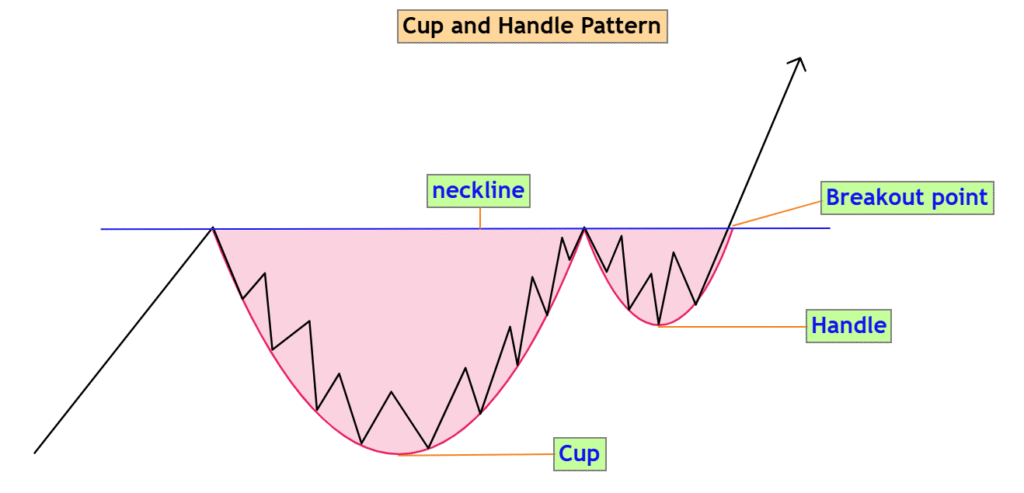
Correct identification is essential. A valid cup formation typically develops after a clear bullish trend, serving as a continuation pattern. In some cases, especially on higher time frames, it may also appear at the end of a downtrend, indicating a potential bullish reversal pattern. In both scenarios, the cup should have a smooth, rounded shape, not a sharp V, and it should not retrace more than 50 percent of the prior move.
The handle formation should remain within the upper third of the cup. It should slope gently downward or move sideways. If the handle dips too deeply or becomes erratic, the pattern loses reliability.
To confirm the setup, draw a horizontal neckline across the cup’s previous highs. A breakout and retest of this level often marks the beginning of a new upward leg. While volume is not always necessary, a rise in buying pressure during the breakout can strengthen the signal.
Entry Points, Stop Loss, and Profit Targets
Once the handle forms and a breakout begins, traders typically choose between three common entry strategies:
Breakout Entry Strategy:
Enter when the price breaks above the handle’s resistance level. This is the most common approach, as it provides confirmation that bullish momentum is taking hold.
Early Entry Strategy:
More aggressive traders may choose to enter while the handle is still forming, ideally near the low of the handle. While this allows for a better price, it also carries more risk if the pattern fails to complete.
Entry After Retest:
Another method is to wait for a breakout above the neckline, followed by a retest. If the price respects the neckline as new support, this offers a more conservative and confirmation-based entry.
Stop Loss Placement:
A common guideline is to place the stop loss just below the lowest point of the handle. This helps limit losses if the breakout fails and the pattern becomes invalid.
Profit Target Calculation:
To set your target, measure the distance from the bottom of the cup to the resistance level (the neckline), then project that same distance upward from the breakout point. For example, if the cup depth is measured accurately, your target would be an equal distance above the breakout. If your stop loss is placed below the handle, this setup can offer a favorable risk-to-reward ratio, such as 2:1.
Some traders prefer to aim for a 3:1 risk-to-reward ratio, adjusting their take profit accordingly. While these targets offer greater profit potential, they may require more time to be reached, especially when trading on higher time frames.
Ready to trade smarter? Use the Top One Trader Position Size Calculator to determine the perfect lot size for every trade based on your stop loss level, account size, and the asset you want to trade.
Example: BTC/USD Cup and Handle Pattern Explained
Let’s take a look at how the cup and handle pattern plays out in a real scenario. Understanding the pattern visually and knowing how to trade it is what turns theory into results.
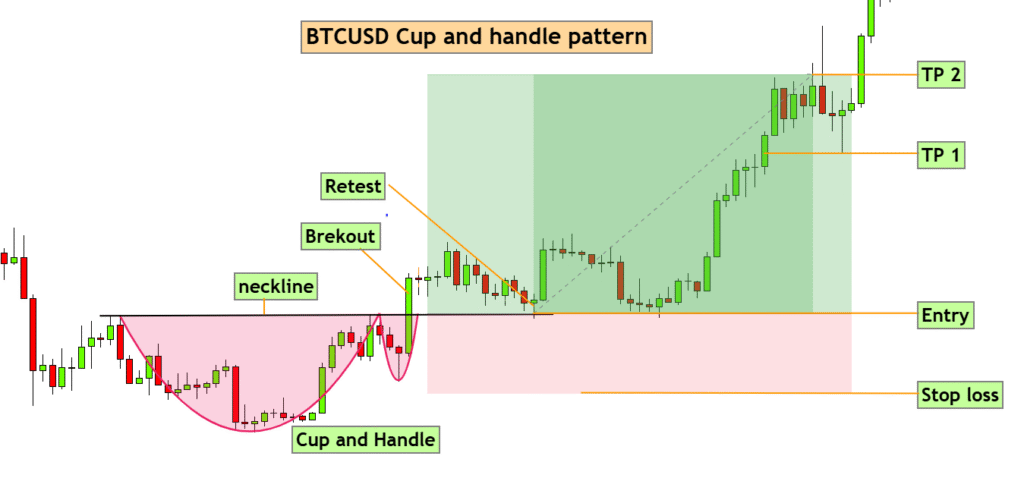
The chart above shows a bullish cup and handle pattern on BTC/USD. The setup begins with a rounded cup formation, where the market gradually recovers from a decline, forming a smooth U-shaped curve that reflects accumulation and a shift in sentiment.
Following the cup, a brief handle formation appears, characterized by a slight downward or sideways drift. This part of the handle pattern bullish structure indicates a short pause in upward momentum and a temporary drop in buying pressure before the next leg higher.
Entry, Stop Loss & Exit Points
- Entry Point: The trade is triggered when the price breaks and retests the neckline, confirming the breakout and providing a clear opportunity to enter with confidence.
- Stop Loss: Set just below the low of the handle to protect against unexpected reversals.
- Exit Points:
- TP1 aims for a 2:1 reward-to-risk ratio.
- TP2 targets a 3:1 reward-to-risk setup if the price continues to trend higher.
- TP1 aims for a 2:1 reward-to-risk ratio.

Common Variations and Inverted Patterns
The cup and handle pattern can appear across timeframes and asset classes, but it doesn’t always look identical.
Intraday vs. Multi-Month Cups
On a 1-hour or 4-hour chart, the pattern might form and complete within a single trading day, offering quick opportunities for scalpers or day traders. These intraday cup and handle patterns are often more volatile but can yield strong moves if confirmed by volume and trend.
In contrast, multi-year cup and handle patterns form slowly over months or even years. These are favored by long-term investors or swing traders who aim to capture larger upward trends.
Inverted Cup and Handle (Bearish Setup)
The inverted cup and handle pattern flips the structure upside down. Instead of forming a rounded bottom, the price creates a rounded top, followed by a slight upward handle formation. This version acts as a bearish pattern.
If the price breaks below the handle’s support level on high volume, it may signal a downtrend. Traders use this setup to go short or exit long positions before further losses occur.
Avoiding False Setups
One of the biggest risks is trading invalid patterns. A few red flags include:
- The cup depth is too steep (more than 50% of the prior trend)
- The handle pattern is too wide or erratic
- The breakout point has low volume confirmation
- The price breaks out before the handle fully forms
In these cases, it’s better to stay patient. An incomplete or sloppy pattern often leads to failed breakouts, hurting your risk-to-reward ratio.
Limitations and Risk Management Tips
No pattern is perfect, and the cup and handle is no exception.
Why the Pattern Fails
The cup and handle pattern can fail for several reasons. Entering too early before a confirmed breakout is one of the most common mistakes, often leading to false breakouts. Low volume can also weaken the setup, especially in thinly traded markets where the price struggles to follow through.
Other causes include a cup that retraces too deeply, a handle that’s too wide or volatile, or breakouts that happen during sideways or unstable market conditions. Strong resistance above the neckline or ignoring confirmation from volume and candlestick patterns can also lead to failure.
How to Improve Your Success Rate
To trade the cup and handle pattern more effectively, focus on confirmation and structure. Wait for a confirmed breakout with supporting volume to reduce the risk of false signals. Place your stop loss just below the handle to protect against sudden reversals. Avoid trading this pattern against the trend or during periods of high market volatility, as these conditions can weaken its reliability. Using additional tools like RSI, moving averages, or other technical indicators can provide stronger confirmation. Finally, always adjust your position size according to your capital size. Consistent results come from disciplined execution, not just spotting the pattern.

Final Thoughts: Is the Cup and Handle Pattern Right for You?
The cup and handle is one of the most dependable patterns in technical analysis, offering traders a visual roadmap for potential trend continuation in a bullish trend. This formation begins with a rounded cup, followed by a brief consolidation phase known as the handle, that sets the stage for a breakout when price hits the neckline with conviction.
It can form in just a few hours, a few weeks, or even span over several years, making it useful for day trading, swing trading, and long-term investing. When supported by volume indicators and confirmation with candlestick patterns, the setup can provide high-probability entries with clearly defined risk and target price levels.
Still, it’s essential to remain cautious during market volatility and to watch for signs of weakening momentum or selling pressure. No pattern is foolproof, but the key to making it work lies in disciplined execution.
To succeed in trading and make better trading decisions, you should have a solid trading strategy, a strict risk management plan, and strong control over your emotions. When used as part of a structured system, the cup and handle can be a powerful signal that helps you trade with more clarity, confidence, and consistency.
Take your trading to the next level with Top One Trader. Get real-time dashboards, educational resources, trade analytics, and tailored challenges all designed to support your growth and strategy.
Is Prop Trading Worth It?
Proprietary trading, often called prop trading, is a model where traders use a firm’s capital instead of their own money to execute trades in the financial markets. In return, they receive a share of the profits generated. This setup is appealing to many aspiring traders and experienced traders alike because it offers the chance to trade large amounts without the fear of losing personal savings.
So, how does it work in practice?
Most prop trading firms operate through a funded trading account model. To access the firm’s money, traders usually complete an evaluation phase, often called a challenge, that tests their ability to follow risk management rules and meet profit targets. This challenge can include one, two, or even three phases, depending on the firm.
If successful, the trader is funded with capital ranging from $5,000 to over $200,000. Once funded, traders use the firm’s capital to execute trades and keep a large share of profits through a profit-sharing model. Unlike retail traders who risk their own limited funds, prop traders gain access to more capital, advanced trading tools, and professional platforms. This model is ideal for skilled traders with limited personal resources.

Benefits of Prop Trading: Why Many Traders Are Making the Switch
The rise of proprietary trading firms has created a new path for traders who want to go beyond traditional retail trading. Here’s why many are making the switch:
Capital Access Without Personal Risk
Perhaps the biggest appeal of prop trading is that it allows traders to access significant capital without putting their personal savings at risk. Instead of trading with a small account, they can manage large funded accounts, opening the door to greater profit potential.
On top of that, many prop firms offer leverage while absorbing the downside risk themselves, so losses don’t come out of the trader’s pocket, as long as they stay within the firm’s rules.
Beyond the initial evaluation fee, there’s no need to invest your own money, which makes this model especially attractive for traders who want to build skills and earn without risking their personal finances.
Professional Tools and Platforms
Many prop trading firms offer access to institutional-grade trading platforms, real-time data feeds, and advanced tools that give traders a competitive edge. These resources can significantly improve your trading performance, especially compared to retail brokers that lack direct market access or high-speed execution.
Training and Mentorship
Some of the best prop firms also provide education, trading simulators, and mentorship programs. This structured support helps aspiring traders transition into consistent professionals, offering the kind of learning environment rarely found in retail trading.
Performance-Based Scaling
Many prop firms use a tiered system where your access to capital increases as your performance improves. This means skilled traders can scale up and grow their income potential over time without needing to deposit more funds.
Stay Ahead with Top One Trader’s Economic Calendar
Track key market events in real time and execute trades with confidence. Use Top One Trader’s free economic calendar to stay one step ahead.

Risks and Challenges to Be Aware Of
While prop firms offer plenty of upside, it’s not without its risks. To succeed, traders need to be aware of the following challenges:
1. The Evaluation Process
Before you get a funded account, most prop firms require traders to complete an evaluation or challenge. This test can be demanding, requiring strict adherence to risk management rules and consistent profitability within a limited time. Many traders fail here due to overtrading, emotional decisions, or poor strategy.
2. Firm Rules and Restrictions
Prop firms enforce strict rules to protect their capital, such as daily and overall drawdown limits, and minimum trading days. Many also ban high-frequency trading (HFT) and disallow risky strategies, including traders who oversize lots to get quick gains and pass challenge phases rapidly.
Even if a trader makes big profits in one day, they may still not get funded until they prove consistency, such as showing steady profits over several days without hitting daily or overall drawdown limits.
3. Mental Pressure
Trading with someone else’s money doesn’t eliminate stress. In fact, it can increase it. The pressure to perform and stay within tight guidelines can lead to emotional burnout. Successful prop traders must have mental resilience, patience, and the ability to stay calm under pressure.
4. Not All Firms Are Legit
Unfortunately, not all prop firms are created equal. Some may have hidden costs, unclear payout policies, or misleading profit splits. It’s essential to choose a reputable firm with transparent terms, good support, and a strong trading community.

Is Prop Trading a Good Career Choice?
For those passionate about financial markets and who value independence, prop trading can be more than just a side hustle; it has the potential to become a life-changing full-time career. If you take trading seriously, build a solid strategy, follow a risk management plan, and develop the right mindset, the opportunities are real. Prop trading rewards discipline and consistency, not luck. With commitment and growth, it can offer financial freedom, flexible work, and long-term career potential. This is what prop trading offers:
1. Strong Income Potential
Successful traders at prop firms can earn significant income through profit sharing. While newcomers might start with modest payouts, prop traders often bring in thousands per month without risking personal capital. With consistency and discipline, some even reach six-figure earnings by scaling up and hitting firm targets.
2. Flexibility With Structure
Prop trading combines the freedom of being your own boss with the benefits of working within a system. You can trade from anywhere, set your own hours, and follow your personal strategy, yet still gain access to professional tools, infrastructure, and mentorship. It’s ideal for traders who value independence but also appreciate support and structure.
3. Real Career Growth
Many traders use prop firms as a launchpad for bigger opportunities, moving into roles at hedge funds, institutional trading desks, or even starting their own firms. Others stay in the prop world, growing their funded accounts or mentoring newer traders. It’s a career path with genuine long-term potential.
Who Is Prop Trading Best Suited For?
Prop trading isn’t for everyone; it’s a performance-driven path that rewards skill, discipline, and emotional control. So, who is most likely to succeed?
1. Intermediate and Experienced Traders Looking for Bigger Capital
Prop firms are ideal for traders who need large capital and have developed their skills through experience. If you’ve been trading with consistency and feel held back by limited capital, prop trading offers access to larger funding and a chance to grow your returns.
2. Disciplined and Rule-Oriented Individuals
Success in prop trading requires following strict guidelines such as drawdown limits, position sizing rules, and time-based evaluation phases. Traders who stick to a plan and respect risk management tend to thrive in these environments.
3. Mentally Resilient and Risk-Aware Traders
Even without using personal funds, trading under pressure can be mentally challenging. The most successful prop traders are those who can manage emotions, stay calm during losing streaks, and make rational decisions under stress.
How to Choose the Right Prop Firm
Not all prop firms are created equal, and picking the wrong one can cost you more than just money. It can waste your time, drain your confidence, and stall your progress. Here’s what to consider when choosing the right prop trading firm:
1. Payout Structure
The profit split is one of the most important aspects to check. Good prop firms typically offer traders between 70% to 90% of the profits, and in some cases, even 100% if the trader proves consistent profitability over time. Be cautious with firms that offer unusually low splits or are unclear about payment terms. Always look for a firm that pays on time, offers fast withdrawals, and has a transparent profit-sharing model.
2. Rules and Trading Restrictions
While we covered trading rules earlier, it’s worth repeating that prop firms implement rules to protect their capital and to separate disciplined traders from gamblers. These rules can include drawdown limits, time restrictions, or strategy limitations.
Serious traders who follow a structured plan and risk management framework typically have no issues. However, if a firm has unrealistic or constantly shifting rules, it may be a red flag. Some firms are designed to make you fail and lose your challenge fee, regardless of your skill.
3. Transparency and Reputation
A reputable prop firm will clearly outline its evaluation process, funding conditions, and policies from the start. Avoid firms that change rules mid-challenge or hide key terms in fine print. To assess a firm’s trustworthiness, you can:
- Ask for opinions in reliable trading communities
- Check platforms like Trustpilot, which provide user-based reviews and company scores
- Visit sites like propfirmmatch.com, which compare prop firms based on their strengths, weaknesses, and detailed descriptions including supported trading styles, firm rules, account types, and other useful information.
4. Trading Community and Support
A strong community can make a big difference. Some prop firms offer access to Discord groups, mentorship programs, webinars, or performance feedback. These tools not only build confidence but also help you learn from others. A firm that invests in trader development, not just challenge fees, is a good sign.
5. Evaluation Costs and Scaling Potential
Finally, consider the entry cost. Some firms charge high fees for evaluations with little chance of funding. Others offer affordable pricing and scaling programs, where successful traders can gradually manage larger accounts. Choose a firm that gives you room to grow without holding back your progress.
Overall, the right prop firm should align with your trading style, goals. It should offer a transparent path to funding and help you grow, not trap you with hidden costs or shifting goalposts.
Key Factors That Influence Profitability and Success
Whether you’re a funded trader or just getting started, long-term success in prop trading depends on more than just good luck or picking the right firm. Here are the main drivers of consistent profitability and performance:
| Key Success Factor | Explanation |
| Effective Risk Management | A strong trading strategy starts with proper risk control. Traders must respect drawdown limits, use correct position sizing, avoid revenge trading, and set clear stop losses. These rules form the foundation of long-term sustainability in prop trading. |
| A Tested and Adaptable Strategy | Successful traders rely on strategies that have been tested and refined across various market conditions. Whether using technical or fundamental analysis, or advanced techniques, consistency and clear rules for entry and exit are essential. |
| Strong Mindset and Emotional Control | The best traders stay calm during drawdowns and don’t let emotions override their plans. Developing discipline through methods like meditation or journaling helps build the resilience needed to stay on track during tough periods. |
| Alignment With Firm Rules | Each prop firm has unique guidelines. Traders must ensure their style fits the firm’s requirements on risk, timing, and instruments. Misalignment can limit success even for skilled traders. |
| Consistent Performance and Scaling | Most firms reward consistent profitability with account scaling. It’s not about one lucky day, but maintaining solid results over time. Consistency builds trust and opens doors to greater opportunities within the prop trading structure. |
To summarize: Success in prop trading is not about winning every trade. It’s about combining risk management, psychological resilience, a tested strategy, and alignment with your firm’s framework.

Conclusion
So, is prop trading worth it? For traders who are disciplined, goal-oriented, and serious about developing their trading skills, the answer is yes.
Prop trading allows you to execute trades with a firm’s capital, removing the personal financial risk while giving you access to a funded trading account, advanced trading strategies, and professional trading platforms. Most prop firms offer the structure and tools needed to help traders succeed, especially when paired with a disciplined trading strategy and a willingness to grow.
Start your journey with Top One Trader, where funded accounts, educational resources, and everything you need to succeed as a trader come together.