
How to Pass Prop Firm Challenge: Essential Tips for Success
Checked by the Top One Trader editorial team, experienced traders and analysts are committed to providing reliable, practical insights for funded trading success.
Ever wondered how traders get funded by prop firms without risking their own capital? The answer is the prop firm challenge, a structured evaluation where traders must prove they can achieve profit targets while respecting strict drawdown and risk rules.
Passing unlocks access to large trading capital, generous profit splits, and scaling opportunities that personal accounts rarely provide. At the same time, these challenges are intentionally tough, designed to filter out impulsive or inconsistent traders.
In this guide, you will learn how to pass a prop firm challenge through strategy, risk management, psychological discipline, and long-term consistency.
Key Takeaway
- Build a winning strategy with clear rules, align it with the firm’s conditions, and respect profit targets, drawdown limits, and trading restrictions while applying strict risk management to protect capital.
- Stay disciplined and maintain emotional control, proving that you can manage capital responsibly and achieve long-term trading success, not just by passing the challenge.
Prop Firm Challenges Explained: Rules, Requirements, and How They Work
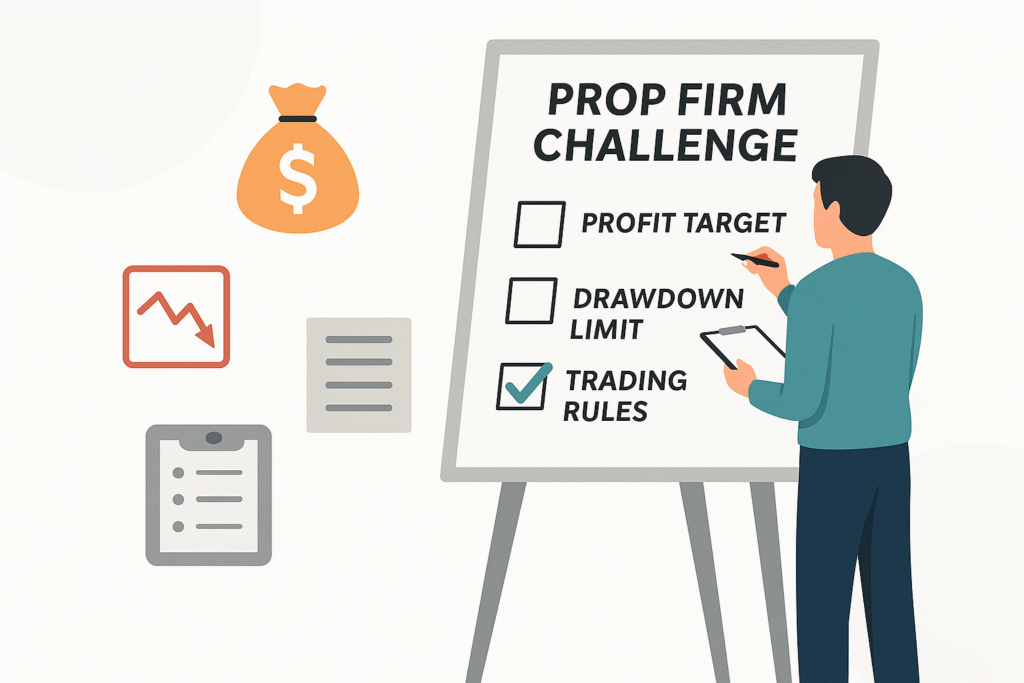
What Is a Prop Firm Challenge?
A prop firm challenge is an evaluation stage where traders use a demo account with virtual funds to prove they can trade profitably while respecting strict risk management rules.
The goal is simple: reach a predefined profit target while staying within drawdown limits and following the rules set by the firm.
Challenges may vary between firms, as each prop firm has its own rules regarding the number of steps to pass a challenge, drawdown limits, account sizes, and other trading restrictions.
Passing the challenge unlocks access to a funded account, profit splits, and scaling opportunities. However, failing to follow the rules results in losing the evaluation fee and having to start over.
Understanding the Firm’s Rules and Requirements
Every prop firm has unique requirements, and knowing them upfront is critical to success.
Typical rules include:
• Profit targets of 5–10%
• Daily drawdown limits of around 4–5%
• Overall drawdown limits of 8–10%
• Passing structure, which may involve 1-step, 2-step, or 3-step challenges depending on the firm and the type of challenge chosen
Beyond the numbers, some firms may also restrict certain trading styles. For example, some ban high-frequency trading (HFT), trading during high-impact news, or holding positions overnight or over weekends. Others may prohibit overleveraging or limit which instruments can be traded.
This is why reading the firm’s terms carefully is essential. Many traders fail not because of a poor strategy, but because they overlooked a specific rule. Aligning your trading plan with the firm’s conditions greatly increases your chances of passing the challenge and becoming a funded trader.
Building a Winning Trading Strategy

One of the first steps to pass a prop firm challenge is developing a trading strategy that not only suits your personality but also aligns with the rules of prop trading firms. A strategy is more than just entries and exits; it’s how you read the financial markets, apply technical analysis, fundamental analysis, and manage trades from the beginning to the end.
Trading styles you can choose from
• Swing trading: captures bigger moves by holding positions for several days. It is less stressful but may not always offer enough opportunities within the challenge period.
• Scalping: looks for small, quick gains. This style offers many entries but carries higher financial risk and may breach trading restrictions like daily drawdowns. Some prop firms also restrict high-frequency approaches.
• Day trading: often the most balanced option, allowing multiple trades per week without holding overnight. It helps meet minimum trading days while controlling exposure with stop loss orders.
Popular trading strategies include
• Trend following: aligning trades with the prevailing market direction and holding winners until momentum slows.
• Supply and demand: identifying price zones where institutions may buy or sell, often leading to strong reversals.
• Breakout trading: entering trades when the price breaks through key support, resistance, or consolidation zones.
• Mean reversion: assuming prices return to average levels after extreme moves.
• Fundamental analysis: making decisions based on economic data, interest rates, or news events, often paired with technical analysis for timing.
Ready to put your trading strategy into action?
Join Top One Trader and apply your skills in a funded account with capital up to $500,000, fast payouts, and industry-leading support. Prove your consistency, trade with confidence, and grow within a supportive trading community.
The right approach depends on your skills, temperament, and the firm’s rules, but what prop firms value most is consistency across different market conditions. Backtesting is essential to confirm win rates, drawdowns, and that your system has a real edge.
Your strategy must also respect firm rules by avoiding weekend holds if they are banned, stepping aside during high-impact news, and managing risk carefully. Breaking the goal into smaller milestones is smarter, aiming for 0.5-1% per day instead of forcing the full 10% target at once. This steady approach builds confidence, protects capital, and keeps you on track to pass the challenge.
Risk Management: The Deciding Factor

If there is one principle that separates traders who pass prop firm challenges from those who fail, it is risk management. Prop trading firms design their rules to eliminate reckless traders. To succeed, you must treat risk management not as an afterthought but as the foundation of your trading plan.
Position Sizing and Stop Loss Orders
Before entering any trade, know exactly how much you are willing to lose. For a funded account, the ideal risk is usually 0.25% to 0.5% per trade. This keeps you conservative, able to survive losses, and still recover. Stop loss orders should be placed at logical technical levels, not randomly. The balance of proper sizing and precise stop placement is what protects you from significant losses and keeps you within firm rules.
Risk to Reward Ratio
A strong trade setup always has a clearly defined risk-to-reward ratio. Many funded traders aim for at least 1:2, meaning if you risk 50 dollars, you aim to make 100 dollars. With this approach, even a 40% win rate can keep you profitable. Success is not about winning every trade but about ensuring that your winners outweigh your losers.
Planning Your Risk
You should create clear rules for how much you risk per trade, per day, and per week. This structure ensures that even during a losing streak, you stay within the firm’s drawdown limits.
Remember that when you open a trade, you never know how much you will win, even with the best strategy. Losses are always possible. The only thing you can control is how much you are willing to lose. That control comes from adjusting position size and placing stop loss orders correctly.
Managing Drawdowns
Drawdowns are the hardest stage of every trader’s journey. Consecutive losses test both discipline and emotional control. The natural instinct is to increase the lot size to recover quickly, but this usually makes the situation worse. A proper risk management plan protects you during these periods. If you reduce size temporarily, stay disciplined, and avoid breaking rules, you give yourself the chance to recover slowly and steadily.
Survival Over Speed
Most traders who fail a prop firm challenge do so because they rush and treat the account like a lottery ticket. Passing requires patience. A steady half percent here and one percent there is enough to build towards the target without unnecessary stress.
The firm does not care how fast you reach the goal. What they want is to see that you can protect capital and respect rules. If you can survive the difficult periods without breaking limits, opportunities will always come.
Psychology and Discipline in Prop Trading

Even with a strong trading strategy and solid risk management rules, psychology can make or break your performance. A prop firm challenge is more than just an evaluation of trading skills on a demo account. It is a pressure test where prop trading firms measure not only your technical analysis and ability to read market trends, but also your emotional discipline under stress.
Psychological Challenges That Sabotage Traders
• Greed pushes traders to aim for bigger gains than necessary, which leads to oversized trades that can hit maximum loss levels.
Fix: Stick to your trading plan and take profits at predefined levels instead of chasing more.
• Revenge trading happens when traders try to recover significant losses by forcing entries, which usually makes drawdowns worse.
Fix: Step away after consecutive losses and review your trading journal before placing another trade.
• Overtrading occurs when traders take setups that do not fit their trading plan just to stay active, leading to unnecessary mistakes.
Fix: Limit the number of trades per day or week and focus on quality setups.
• Fear often makes traders exit winning trades too early, cutting potential profits short and limiting long-term growth.
Fix: Trust your stop loss orders and let trades reach the planned profit target before closing.
• Hesitation prevents traders from taking valid setups, especially after consecutive losses, which results in missed opportunities and broken consistency.
Fix: Backtest your strategy so you have confidence in its edge, and commit to following signals when they appear.
These traps can undo weeks of progress in a single trade. It is easy to say the market does not work or that it is not your fault, but the key to success is becoming accountable and taking responsibility for every decision you make.
Building Discipline and Good Habits
Discipline is the foundation of passing a prop firm challenge because it ensures you can follow your trading plan consistently, control risk, and avoid impulsive mistakes. Without discipline, even the best strategy will fail under pressure.
The most successful traders build routines that keep them focused across market conditions.
Journaling trades, including entry reasons, stop loss placement, and emotions, helps track decisions and identify patterns.
Reviewing the economic calendar and marking key levels prepares you for volatility and reduces impulsive trades.
Regular backtesting sharpens your system, while continuous learning keeps you adaptable as markets change.
Passing a prop firm challenge is not about winning every trade but about consistent execution, controlled risk, and steady progress. Firms value disciplined traders over those who chase quick profits. Completing a challenge is only the beginning. The real journey starts with a funded account, where larger allocations and profit splits depend on long-term consistency.
Mastering your mind is essential, as emotional control, patience, and accountability protect capital and support steady growth across market conditions. Traders can earn significant income from funded accounts if they stay disciplined and stick to their trading plan.
Conclusion
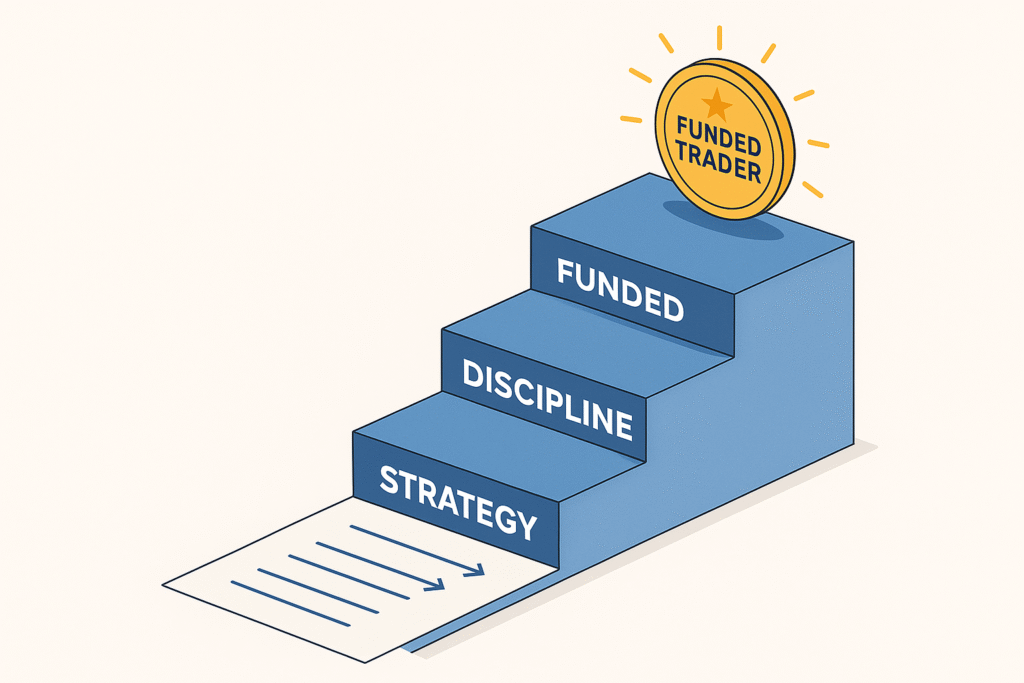
Passing a prop firm challenge is not about speed or luck; it is about proving that you can trade with discipline, consistency, and respect for risk. A strong trading strategy aligned with firm rules, backed by proper backtesting and risk management, gives you the foundation to succeed.
Just as important is mastering psychology, since emotional control determines whether you can stay consistent under pressure. Remember, the challenge is only the first step. Long-term success comes from treating trading like a profession, building habits that protect capital, and steadily compounding profits over time.
Ready to Prove Your Skills?
Join Top One Trader today and take on a prop firm challenge with capital allocations up to $500,000, fast payouts, and a supportive trading community. Start your journey to becoming a consistently funded trader now.
Forex Terminology: Key Terms Every Trader Should Know
Checked by the Top One Trader editorial team, experienced traders and analysts are committed to providing reliable, practical insights for funded trading success.
Ever wondered what traders really mean when they talk about pips, spreads, or leverage? Stepping into the forex market can feel overwhelming if you don’t speak the language. Every trade, chart, and strategy depends on a set of terms that explain how currency trading works.
In this guide, we’ll break down the most important forex terminology so you can trade with clarity and confidence. From currency pairs and trade sizes to leverage, orders, and risk management, you’ll gain the foundation needed to navigate the world’s largest financial market like a professional.
Quick Overview
- Understanding Forex Terminology helps traders interpret currency pairs, pips, spreads, and leverage, enabling clearer decisions and better risk management.
- Applying Key Terms in Practice improves trading strategy, supports disciplined market analysis, and enhances long-term success in forex trading.
Basics of the Forex Market

Ever wondered why the forex market is so different from stocks or commodities? The truth is that its size, liquidity, and participants make it unique, and these basics form the foundation every trader needs to understand. Let’s break it down step by step.
Forex Market
The forex market is the largest financial market in the world, with daily trading volumes above $7 trillion. It operates 24/5 across global hubs, giving forex traders unlimited opportunities. Unlike stocks, forex trading has no central exchange, making it a truly global and decentralised market.
Liquidity
Liquidity means how easily currencies can be bought or sold without sharp swings. At the end of the day, this deep liquidity makes forex attractive to traders.
Market Participants
From banks and hedge funds to corporations and retail forex traders, many players drive supply and demand. Central banks are especially powerful, influencing currency trading through interest rates and policy.
Monetary Policy
Think of monetary policy as the steering wheel of the foreign exchange market. Rate hikes usually strengthen a national currency, while cuts often weaken it. Financial decisions frequently reflect efforts to manage inflation, employment, and overall price stability in the economy.
Currency Pairs and Exchange Rates
At its core, forex is about exchanging one currency for another. A currency pair consists of a base and a quote. For example, in EUR/USD, the euro is the base and the U.S. dollar the quote. The exchange rate shows their relative value, such as EUR/USD = 1.10, meaning one euro equals 1.10 U.S. dollars.
Major pairs like EUR/USD, GBP/USD, and AUD/USD dominate daily trading volumes with high liquidity and tight spreads. If EUR/USD rises, the euro strengthens against the dollar; if it falls, the euro weakens. This quotation structure helps forex traders identify trends, set entry and exit points, and refine a trading strategy.
Price Influences
You might be surprised by how many factors affect exchange rates. Interest rates, GDP growth, unemployment rates, inflation, and geopolitical events all contribute to market volatility. Central banks and government policies also play a major role in shaping currency prices and overall price stability.
Trade Sizes, Units, and Orders

Let’s say you already understand how currency pairs work. The next step is learning trade sizes and how positions and orders work, because the size of your trade, the smallest price movement (pip), and the type of order you place all determine your profit or loss.
Believe it or not, many beginners overlook this, and it directly affects risk management.
1 – Lot Size and Position Sizing
Forex trades are measured in lots: a standard lot equals 100,000 units, a mini lot equals 10,000, and a micro lot equals 1,000. Smaller lots give beginners more control over risk.
Position sizing is just as important; adjusting trade size based on your account balance ensures you don’t risk too much on a single trade.
2 – Pips and Pip Value
A pip (percentage in point) is the smallest unit of movement in forex, usually the fourth decimal place. For example, if EUR/USD moves from 1.1050 to 1.1051, that’s a one-pip change. The value of a pip depends on lot size, with larger lots making each pip movement have a greater impact on profits or losses.
3 – Risk Management
At the end of the day, both lot size and pip value tie directly into risk management. Understanding how each price movement impacts your account is critical to surviving in the forex market.
4 – Trading Positions (Long and Short)
In forex trading, a long position means buying a currency pair, expecting the base currency to increase in value against the quote. Traders usually go long when they are bullish on the market.
By contrast, a short position means selling a currency pair, anticipating that the base currency will weaken. This allows traders to profit in falling markets.
5 – Market Order
A market order executes instantly at the current price. It’s the fastest way to enter or exit, though in volatile markets, slippage can occur.
6 – Limit Order
Suppose EUR/USD moves toward your chosen price level. A limit order ensures your trade is executed at that level, not just the current market price.
7 – Stop-Loss and Take-Profit Orders:
You might be surprised how many traders ignore these. Stop-loss and take-profit orders define your entry and exit, protecting your capital and automatically locking in profits.
Want to make position sizing easier? Instead of doing the math manually, use the Top One Trader Position Size Calculator to quickly find the right lot size and manage your risk with confidence.
Leverage, Margin, and Account Balance
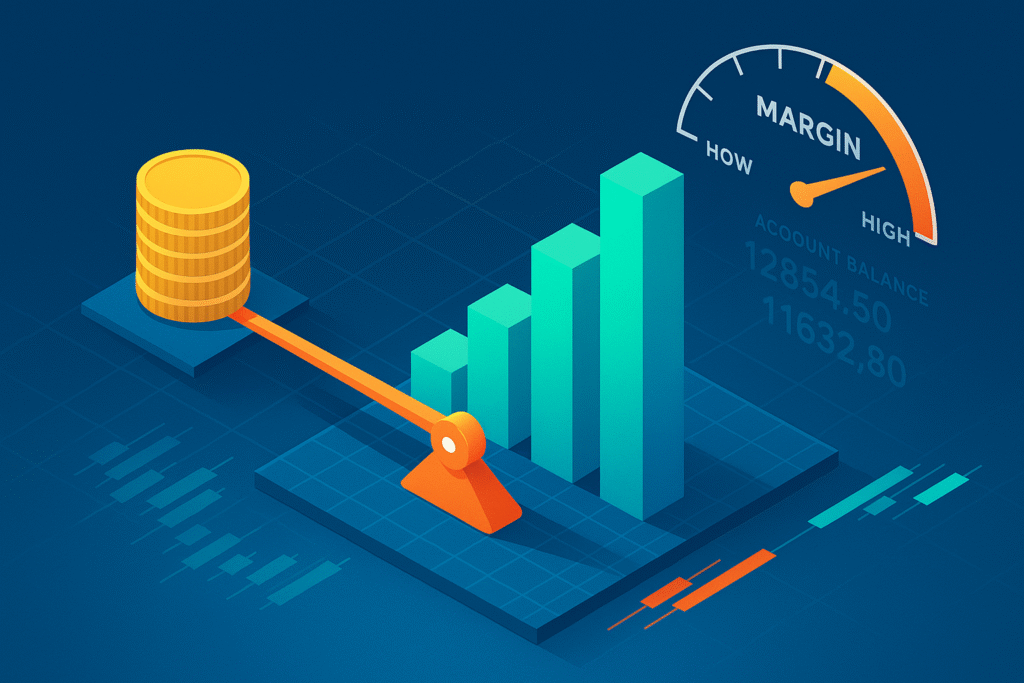
Leverage and margin are two of the most powerful and riskiest tools in forex. In other words, they give traders access to much larger positions than their deposit allows, but without proper risk management, they can quickly wipe out an account.
Leverage
Think of leverage as a magnifying glass. It lets traders control large trades with a small deposit. For example, 100:1 leverage means $1,000 can control a $100,000 position. The reality is that this can multiply both profits and losses.
Margin and Margin Call
Margin is the deposit required by forex brokers to open a leveraged trade, acting as a security buffer to ensure you have funds in the game. A margin call happens when your account balance falls below the broker’s required margin level, which can lead to open positions being closed automatically unless more funds are added.
Equity
Equity reflects your account’s real-time value, including open positions. At the end of the day, monitoring equity closely helps prevent being caught off guard by sudden price movements.
Open Positions
You’ll notice that open positions are trades still active in the market. Keeping track of margin usage, required margin level, and equity across these positions is key to managing account balance safely.
PnL (Profit and Losses)
PnL represents the outcome of your trades. Realised PnL is the profit or loss from closed trades, while unrealised PnL reflects the changing value of open positions as prices move. Together, they show whether your account is gaining or losing money at any moment.
Forex Market Analysis

Let’s break it down: no trader can succeed without strong market analysis.
The fact is that trading decisions rely on studying historical price data, using technical analysis tools, and following fundamental analysis of economic events.
Technical Analysis: In practice, technical analysis uses charts and historical forex prices to forecast future moves. Traders rely on price action, such as candlestick patterns, as well as technical indicators like moving averages, RSI, and MACD to identify trends, refine strategies, and pinpoint entry and exit points.
Fundamental Analysis: Fundamental analysis focuses on the bigger picture. Interest rates, unemployment rates, political stability, and geopolitical events often create sharp volatility in forex markets.
Identify Trends: As you might guess, one of the main goals of analysis is to identify trends. Recognising whether the market is trending or ranging helps you apply the right trading strategy.
Price Level: On the other hand, every piece of analysis eventually comes back to the price level. Whether you’re using a chart pattern, resistance level, or reacting to news, forex prices guide entry and exit decisions.
Psychology and Risk Management

Many traders fail not because of bad technical analysis or poor understanding of forex prices, but because of emotions. The truth is that psychology and risk management often decide whether you succeed or struggle in trading.
At the end of the day, discipline is just as important as any strategy.
Risk/Reward Ratio
Here’s the catch: the risk/reward ratio compares potential profit with potential loss. By sticking to positive ratios, traders can survive long-term even with average win rates.
Stop-Loss Orders
You’ll notice that stop-loss orders are a trader’s safety net. They protect against unexpected moves and enforce discipline, taking emotions out of the decision.
Emotional Decision Making
The point is that fear and greed are the biggest enemies. Emotional decision-making often leads to errors, while staying calm and logical keeps your trading strategy intact.
Revenge Trading
At the end of the day, revenge trading is one of the costliest mistakes. Chasing losses by placing impulsive trades usually compounds errors and drains your account balance.
Fear and Greed
Fear often leads traders to close winning trades too early or avoid good setups, while greed pushes them to over-leverage, ignore stop-losses, or chase the market. Both emotions cause emotional decision-making instead of following a trading strategy. Managing fear and greed with discipline and risk management is essential for long-term success.
Additional Trading Terms to Know

For example, beyond the basics, forex has additional terms that shape costs, strategies, and real-world trading decisions. Picture this: knowing about CFDs, carry trades, and spreads can save you from costly surprises.
CFDs (Contracts for Difference): Let’s say you want to speculate on currency prices without owning the actual asset. CFDs allow exactly that, offering flexibility but also adding fees and leverage risks.
Swap and Rollover: You might be surprised by this: holding a trade overnight often triggers a swap or rollover. Depending on the interest rate differences, you’ll either pay a fee or receive a credit.
Spread: The spread is the difference between the bid (sell) price and the ask (buy) price. It represents the basic cost of entering a trade. Active forex traders prefer tighter spreads because they lower overall costs and make short-term strategies more efficient.
Trading Costs: Beyond the spread, traders also face other costs such as swaps, commissions, and slippage. These additional trading costs directly affect account balance and profitability. Factoring them into your risk management and trading strategy is essential to ensure that profits remain sustainable after expenses.
Conclusion

Learning forex terminology is the first step to trading with confidence. By understanding key concepts like currency pairs, lots, pips, leverage, and margin, you gain the tools to interpret price movements and manage risk effectively. Beyond definitions, strong market analysis and disciplined risk management ensure strategies remain sustainable.
Just as important is psychology. Patience and discipline often decide whether traders succeed or fail. Whether you’re starting out or sharpening your skills, applying this knowledge in practice will help you trade smarter, avoid costly mistakes, and build a solid foundation for long-term success in the forex market.
Ready to put your knowledge into action? Join Top One Trader today and get access to educational content, flexible funded accounts up to $500,000, advanced trading platforms, and a supportive trader community with 24/7 assistance. Start your journey with confidence.
Richest Forex Traders in the World 2025 | Top One Trader Guide
Checked by the Top One Trader editorial team, experienced traders and analysts are committed to providing reliable, practical insights for funded trading success.
The financial markets have always produced legendary traders and investors, and some of the most remarkable success stories come from the forex market. As the world’s largest and most liquid market, forex has shaped traders who have built extraordinary fortunes and secured their place in trading history.
Figures like George Soros, Bill Lipschutz, and Stanley Druckenmiller became icons through their discipline, strategy, and ability to manage risk under pressure.
In this article, we’ll explore the richest and most famous forex traders in history, their unique approaches to the market, and the timeless lessons every trader can learn from their journeys.
Quick Overview
The richest forex traders in the world 2025 include George Soros, Paul Tudor Jones, Bill Lipschutz, Stanley Druckenmiller, and Bruce Kovner, with fortunes from hundreds of millions to over $8 billion. They became wealthy through strategies like global macro speculation, technical analysis, and strict risk management, proving that discipline and psychology are key to lasting success.
The Richest and Most Famous Forex Traders
George Soros – The Man Who Broke the Bank of England

Relied on: Fundamentals / Global Macro
No list of the most successful forex traders is complete without George Soros. He is famous for his legendary short position against the British pound on Black Wednesday (16 September 1992), which earned him $1 billion in a single day and gave him the nickname “the man who broke the Bank of England.”
Through Soros Fund Management and the Quantum Fund, Soros mastered macroeconomic analysis, studying global interest rates, political events, and investor sentiment to place high-conviction trades. His philosophy is rooted in reflexivity, the idea that markets can influence economic fundamentals as much as fundamentals influence markets.
With an estimated net worth of over $8 billion, Soros remains one of the richest forex traders of all time. His lesson: stay adaptive, challenge conventional wisdom, and never underestimate how quickly currency trading can shift when central banks intervene.
Paul Tudor Jones – Combining Fundamentals and Technicals
Relied on: Both Fundamentals & Technical Analysis
Paul Tudor Jones, founder of Tudor Investment Corporation, became famous for predicting the 1987 stock market crash, making over $100 million. While not known for one major currency trade like Soros, he consistently profited from interest rate fluctuations and macro trends in the forex market. His trading style blends technical analysis with global fundamentals, analysing price charts while watching economic signals.
Jones insists the most crucial aspect of trading is protecting capital through strict risk management. With a net worth of around $7 to $8 billion, he shows that combining trading strategies with discipline leads to significant gains.
Bill Lipschutz – The Sultan of Currencies
Relied on: Fundamentals & Market Sentiment
Bill Lipschutz turned a $12,000 inheritance into millions before running Salomon Brothers’ FX desk in the 1980s, where his team generated close to $300 million annually. Known as the “Sultan of Currencies,” Lipschutz emphasized that forex trading is as much about psychology and sentiment as it is about technical or fundamental analysis.
His exact net worth is not publicly disclosed, with estimates ranging from several hundred million to just over $1 billion, but his influence on the forex market is undeniable.
Lipschutz’s main lesson for traders is clear: success in the forex market comes not from chasing wins but from managing losses, controlling emotions, and adapting to market sentiment.
Stanley Druckenmiller – Conviction and Discipline
Relied on: Macro Fundamentals
Working alongside Soros at the Quantum Fund, Stanley Druckenmiller played a critical role in the 1992 pound short. Later, as head of Duquesne Capital Management, he built a reputation for placing large, highly profitable bets when he had conviction.
Druckenmiller emphasizes capital preservation and the discipline to cut losses quickly. His story is a reminder that even the most successful forex traders prioritize defense before offense. With a fortune above $6 billion, he stands among the richest forex traders ever.
Michael Marcus – From $700 to Millions

Relied on: Technical Analysis
Michael Marcus began his trading career with only $700 and eventually turned it into tens of millions. As a member of Commodities Corporation, he specialized in futures and currencies, relying on technical analysis and disciplined rules. He later mentored Bruce Kovner, proving that knowledge and mentorship are as valuable as money in this business.
His success shows that even small beginnings in the trading industry can lead to great wealth when paired with discipline and risk control.
Bruce Kovner – The Risk Manager
Relied on: Macro + Technicals analysis
A student of Marcus, Bruce Kovner, borrowed $3,000 on a credit card for his first trade and turned it into $20,000. He went on to found Caxton Associates, which became one of the most profitable hedge funds of its time.
Kovner’s strength was blending technical timing with a deep understanding of economic fundamentals while keeping risk strictly controlled. He has always emphasized that survival is more important than quick wins, making him a role model for successful trading.
Andrew Krieger – The Aggressive Currency Trader
Relied on: Macro / Fundamentals
Few forex traders are remembered as clearly as Andrew Krieger. In 1987, after the Black Monday crash, he saw weaknesses in the New Zealand dollar and launched a massive short position that even exceeded the country’s money supply. The trade earned his firm over 300 million dollars and made Krieger known as one of the most aggressive yet calculated forex traders of his time.
Krieger’s approach was rooted in macroeconomic analysis, targeting currencies he believed were overvalued. His story shows both the potential rewards and the dangers of using extreme leverage in forex trading.
Joe Lewis – From Currencies to Billionaire Investor
Relied on: Fundamental / Macro Speculation
Net worth: ~ $6 billion
Born in London, Joe Lewis built his wealth initially through currency trading. He partnered with George Soros during the 1992 European Exchange Rate Mechanism crisis, profiting when the British pound collapsed. Reports suggest Lewis personally made around $1.8 billion from that trade alone.
Lewis later diversified into real estate, sports, and other investments, becoming the owner of the Tavistock Group and a majority shareholder in Tottenham Hotspur. Despite moving beyond the forex market, he remains one of the richest forex traders in history, proving how early success in FX can fuel wider financial empires.
Marty Schwartz – The Technical “Pit Bull”
Relied on: Technical Analysis
Marty Schwartz, nicknamed “Pit Bull,” became famous as a short-term trader who relied heavily on price charts and strict rules. After winning the U.S. Investing Championship in 1984, Schwartz cemented his reputation as one of the top forex traders and futures traders in the world.
Featured in Market Wizards, Schwartz emphasized discipline and the importance of sticking to tested trading strategies. By consistently following technical setups and applying strong risk management, he turned steady trades into millions. His story shows that successful trading doesn’t always come from massive one-off bets; consistency can be just as powerful.

The richest forex traders succeeded through discipline and strategy. Top One Trader provides the tools to follow their path with flexible funded accounts, educational content, and advanced trading platforms.
Other Legendary Investors and Traders
Not all successful traders and investors come from the forex market. There are a lot of markets that give infinite opportunities, from bonds and stocks to commodities and currencies.
Warren Buffett – Long-Term Value Investor
Warren Buffett, the “Oracle of Omaha,” is best known for building Berkshire Hathaway into one of the world’s largest investment companies. With a net worth of around $160 to 165 billion in 2025, Buffett is not primarily a forex trader, but he has used the currency market strategically.
Between 2002 and 2005, Berkshire Hathaway held multi-billion-dollar positions in foreign currencies as a hedge against a weakening U.S. dollar. This was not speculative trading but a defensive move to protect the company’s assets.
Buffett’s example shows that even long-term stock investors recognize the role of forex trading in managing global risk. For aspiring traders, it is a reminder that currencies can be a powerful tool not only for speculation but also for preserving capital in uncertain markets.
Jim Simons – The Quantitative Pioneer
Jim Simons, a former mathematician and codebreaker, founded Renaissance Technologies in 1982. His Medallion Fund is considered the most successful hedge fund ever, delivering average net annual returns above 30%.
Renaissance trades across stocks, futures, commodities, and currencies, relying on advanced mathematical models and algorithms. Simons’ approach was fully systematic and data-driven, exploiting small market inefficiencies at a massive scale.
At the time of his death in 2024, his net worth was about $31 billion, and his legacy continues to influence quantitative and algorithmic trading, including in forex.
Ray Dalio – Principles and Systematic Macro
Ray Dalio founded Bridgewater Associates in 1975, which grew into the world’s largest hedge fund, managing over $160 billion at its peak.
Bridgewater follows a macro trading approach, covering currencies, bonds, commodities, and equities through systematic research and principles-based models. Currencies have always played a key role in Dalio’s global strategies, especially in relation to debt cycles, inflation, and interest rates.
As of 2025, his net worth is around $15 billion. Dalio’s work highlights how disciplined, model-driven investing can reduce emotional bias and capture opportunities across markets, including forex.
Lessons from the Richest Forex Traders

| Lesson | Core Takeaway |
| Having a Strategy and an Edge | Success in forex trading is never a matter of luck. Profitable traders build wealth by developing a clear edge, whether through technical analysis, macroeconomic insights, or systematic models. |
| Risk Management Comes First | Survival matters more than any single trade. Protecting capital, cutting losses quickly, and prioritising defense over offense are the foundations of long-term success. |
| Mindset and Psychology | Trading requires discipline, emotional control, and self-awareness. Following rules and removing bias are just as important as market analysis. |
| Consistency Over Time | Lasting wealth comes from applying proven methods repeatedly. Consistency and patience outperform one-off gambles or headline-making wins. |
Conclusion

The richest forex traders and legendary investors prove that there is no single path to success in the financial markets. Some, like George Soros and Bill Lipschutz, relied on currencies as their primary investment vehicles.
In contrast, others, such as Warren Buffett and Ray Dalio, built fortunes in different markets but still turned to forex when opportunities arose. What unites them all is not luck but discipline, risk control, and the ability to stick to a proven strategy.
For aspiring traders, the lesson is simple: focus on building an edge, protect your capital, strengthen your mindset, and stay consistent over time. Success in forex and in any market comes from patience, adaptability, and applying these principles day after day.Inspired by the journeys of legendary forex traders? Start building your own success story with Top One Trader. Choose a funded account that fits your trading style and take the first step toward reaching your goals.
Forex Trading Tips Every Trader Must Know
Checked by the Top One Trader editorial team, experienced traders and analysts are committed to providing reliable, practical insights for funded trading success.
The forex market is the largest financial market in the world, with a daily trading volume exceeding 7 trillion US dollars. This unmatched liquidity offers countless opportunities for profit but also carries significant risks for traders without a solid plan.
Whether you are just starting forex trading or refining your skills as an experienced trader, the right approach can determine the difference between long-term success and costly mistakes.
This guide delivers practical and proven forex trading tips to help traders at all levels navigate the market with confidence, protect their capital, and steadily grow their trading accounts.
Quick Overview
- Learn forex market basics, including currency pairs, price drivers, and basic forex trading strategies to guide your decisions.
- Practice trading on demo accounts to test your trading plan and gain confidence before you start trading with real money.
- Build and backtest a trading plan using clear entry, exit, and risk parameters with the help of technical analysis tools.
- Analyse results in a trading journal to refine your strategy and work toward becoming a successful forex trader.
- Study different financial instruments and market conditions to trade more effectively.
Learn the Basics of the Forex Market
Before jumping into trading, beginners must know the basics to build a clear vision of how the forex market works. At its core, forex trading involves exchanging one currency for another in currency pairs such as EUR/USD or USD/JPY. Each pair has a base currency (listed first) and a quote currency (listed second). The price shows how much of the quote currency is required to buy one unit of the base currency.
The forex market operates 24 hours a day during the trading week, giving traders access to global markets at almost any time. Trading begins when the market opens on Sunday evening and continues until it closes on Friday evening (times vary by timezone). This continuous cycle is possible because major financial centres around the world – such as Sydney, Tokyo, London, and New York – open and close at different times, creating overlapping sessions and constant trading opportunities during the week.
Key basics every beginner should understand include:
- Bid and Ask Prices – The bid is the price at which you can sell, and the ask is the price at which you can buy. The difference between them is called the spread, which represents the broker’s fee or transaction cost.
- Pips – The smallest standard unit of price movement in a currency pair.
- Leverage – Borrowed capital that allows traders to control larger positions with less money, amplifying both profits and losses.
- Lot Sizes – Standardised trade sizes (micro, mini, standard) that determine position value.
- Timeframes – Chart intervals ranging from one minute for scalping to daily or weekly for swing and position trading.
- Technical Analysis Basics – Using tools like trendlines to identify market direction and support and resistance to highlight potential entry and exit points. Technical analysis studies price action and chart patterns to forecast market movements.
- Fundamental Analysis Basics – Examining factors influencing currency prices such as interest rate changes, economic data releases, and geopolitical events. Combining technical and fundamental analysis provides a balanced market view and improves decision-making.
- Types of Orders – For example, market orders (executed immediately at the current price) and stop orders (triggered when the price reaches a specified level).
- Demo Account – A practice account that allows beginners to trade in real market conditions without risking actual money.
By understanding these basics about forex trading, traders can start building their strategy, knowing how to analyse the market, manage risk, and have the right foundation to start their journey in trading. With a solid grasp of the fundamentals, traders can also decide how they want to begin their journey, choosing their preferred type of analysis, selecting timeframes, and discovering what fits their lifestyle, whether that means becoming a swing trader, day trader, or scalper.

Build a Simple, Profitable Trading Strategy
Overcomplicating your strategy leads to confusion, hesitation, and poor execution. Simplicity is key. Keep charts clean, using only drawings and tools that serve a clear purpose.
Choose a trading style that fits your personality and lifestyle. Swing trading captures moves lasting several days, day trading focuses on short-term opportunities within a single day, and scalping targets very quick trades.
While the amount of information may feel overwhelming, you can simplify by structuring your approach into three steps:
Identify the Trend
A profitable strategy begins with recognizing market direction. Use tools like trendlines, market structure, or moving averages to determine whether the market is in an uptrend or a downtrend. Follow the trend, go long in an uptrend and short in a downtrend.
Define Entry Criteria
Decide what conditions must be met before entering a trade, including market signals and any confirmation. Combine price action with candlestick patterns, support/resistance, or Fibonacci retracement to improve probability. Technical indicators like RSI, MACD, or stochastic oscillator can strengthen confirmation.
Set Stop Loss and Take Profit Levels
A stop loss marks the point where your trade idea is invalid, protecting you from significant losses. Take profit locks in gains when the price reaches your target. Experiment with approaches such as price action, trend following, or support/resistance zones. Beginners may take time to build a strategy they can trust and repeat consistently.
Ready to test your strategy? Top One Trader gives you the chance to trade up to $500,000 in funded capital and offers you flexible funded accounts and educational content to support you in achieving your goals.
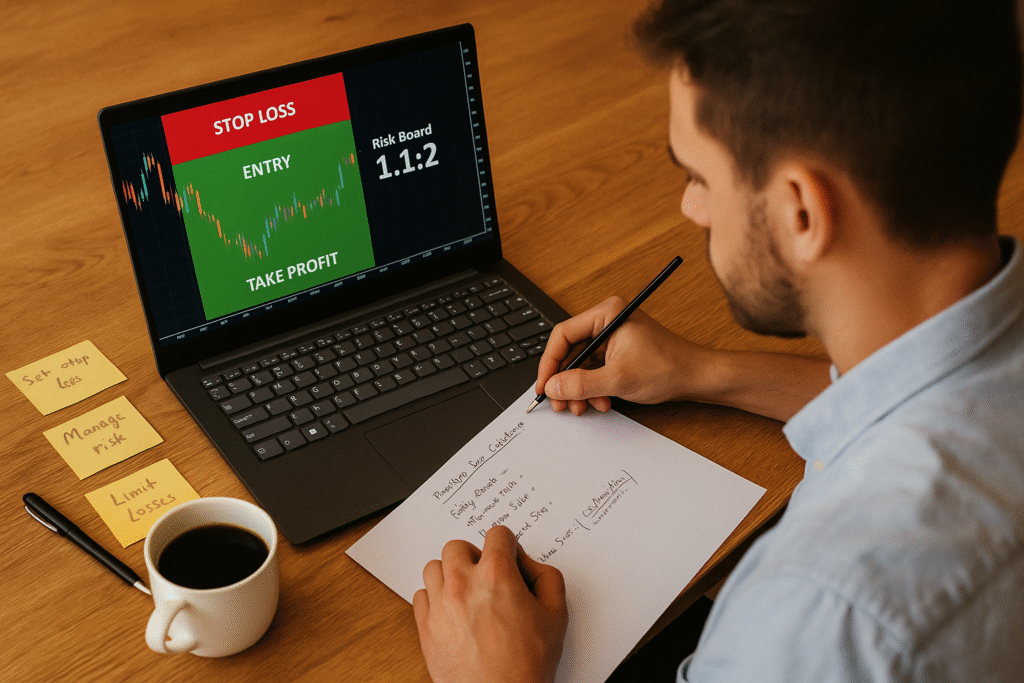
Set a Solid Risk Management Plan
Risk management is essential for protecting your account and ensuring long-term survival in the forex market. Even the best trading strategies can fail without proper control. Two rules should never be broken: always use a stop loss, and only risk capital you can afford to lose.
A stop loss limits potential losses, prevents major drawdowns, and reduces emotional pressure that can lead to poor decisions like revenge trading. Decide how much to risk per trade, typically 0.25 to 0.5 percent of your account balance, and set daily, weekly, or monthly loss limits. Place stops at logical market levels and aim for a favourable risk-to-reward ratio so potential profit meets or exceeds your risk.
Basic practices include avoiding over-leverage, adjusting position size for market volatility, and protecting capital in unfavourable conditions. Advanced methods involve taking partial profits as trades move in your favour, securing gains even if the price reverses.

Backtest and Practice Your Strategy Before Going Live
Backtesting is the process of testing your strategy using historical data to see how it would have performed in different market conditions. You should test your system on multiple forex pairs, multiple timeframes, and various market environments, including uptrends, downtrends, and ranging markets. This helps you gather valuable data such as:
- Win rate of your strategy.
- Profit and loss (P&L) performance.
- Maximum drawdown, which shows the worst losing streak and the limits of your system.
- The market conditions under which your strategy performs poorly and could cause consecutive losses.
- The most effective risk-to-reward ratio for your trades.
With this information, you can refine and optimize your strategy for better results. For example, you may choose to apply it only on specific timeframes, pairs, or market conditions where it performs best. Remember, trading is about knowledge, and the more data you collect, the more informed your decisions will be.
Practicing is just as important. Use a demo account to trade in real market conditions without risking capital. Treat your demo account as if it were real so you get used to following your plan, managing risk, and making decisions under pressure. This process shapes your skills, improves execution, and prepares you for live trading with confidence.
Choose a Reliable Broker or Prop Firm and Understand Their Rules
Choosing the right broker or prop firm is crucial because it directly impacts your ability to trade successfully and safely.
The quality of your provider affects execution speed, platform stability during volatile markets, and whether your strategies can be applied without unnecessary restrictions. You should also clearly understand their operational guidelines, as every broker, prop firm, and trading platform has its own rules regarding drawdowns, leverage limits, margin requirements, minimum lot sizes, and permitted strategies. Not knowing these rules can lead to penalties or even account termination.
Equally important is ensuring the firm pays traders reliably and on time, as payment delays can disrupt your progress. Working with a trusted, transparent provider helps you avoid scammers, protect your capital, and trade with confidence. Before committing real capital, familiarize yourself with the platform’s features through a demo account so you can place, modify, and close trades efficiently, a skill that can make all the difference in fast-moving markets.
What to Look For in a Good Broker or Prop Firm
| Criteria | Details |
| Trustworthiness and Reputation | Work with providers that have a proven track record. Check Trustpilot and Prop Firm Match for reviews. |
| Competitive Costs | Low spreads and commissions with no hidden fees. |
| Fast Execution | Minimal slippage, even during volatile market conditions. |
| Instrument Selection | Access to the markets and financial instruments you plan to trade. |
| Reliable Platform | Stable, easy to use, with quality charting tools. |
| Responsive Support | Support available during your trading hours. |
| Clear Funding Rules (Prop Firms) | Fair profit splits, realistic scaling, and transparent terms. |
| Payout Reliability | Consistent, timely payments with no unnecessary delays. |
| Defined Risk Parameters | Leverage, margin, and drawdown rules that fit your plan. |

Work on Your Mindset and Stay Disciplined
Trading psychology is as important as strategy or risk management. On your journey, you will face emotions such as fear, greed, impatience, anxiety, doubt and frustration, all of which can disrupt your trading plan.
After a losing streak, fear may prevent you from taking the next valid setup, leading to missed profitable trades. Greed can tempt you to add extra positions or move your take profit further, increasing your risk unnecessarily. In both cases, emotions take control, causing broken rules and potential account losses.
The solution is discipline:
- Stay neutral whether winning or losing and follow your trading plan without emotional interference.
- Base your decisions on a clear, tested strategy rather than feelings in the moment.
- Set realistic goals, avoid the idea of doubling your account in a week, and treat trading as a business.
- Focus on steady and sustainable growth for long-term success.

Conclusion – Turning Tips into Action
Trading forex successfully comes from preparation, discipline, and patience. Whether you are a beginner trader just starting or an experienced professional, the path to consistent results is built on understanding the market, applying a clear strategy, and managing risk effectively.
To become a consistent, profitable trader, you should embrace consistency, maintain a long-term vision, and treat your trading as a business rather than a quick gamble. Use your trading experience to refine your plan, and treat losing trades as lessons, not setbacks. Never stop learning from market analysis, new strategies, and evolving conditions to build lasting success in the forex market.
Your journey to becoming a consistent, profitable trader starts with the right environment. Join Top One Trader today for the capital, education, support, and flexibility you need to trade with confidence and achieve your goals.
How to Become a Forex Trader | Top One Trader Guide
Checked by the Top One Trader editorial team, experienced traders and analysts committed to providing reliable, practical insights for funded trading success.
Becoming a forex trader is more than placing trades – it’s a journey of learning, building a system, and growing your mindset. From mastering the basics and choosing the right tools to developing a strategy and managing risk, each phase helps shape you into a more consistent, profitable trader.
It’s not an overnight success path, but a process of discipline, self-awareness, and continuous improvement. Whether you’re a complete beginner or transitioning from demo to live trading, this guide will help you navigate each key stage.
In this article, we will explore how to become a forex trader step by step.
Quick Overview
- Learn forex market basics, including currency pairs and price drivers.
- Practise on demo accounts before trading real money to gain confidence.
- Build and backtest a trading system with clear rules and risk parameters.
- Develop a strong trading psychology and mindset to handle emotions and stay disciplined.
- Apply strict risk management to protect capital and avoid unnecessary losses.
Table of Contents
Understanding the Forex Market

The forex market operates differently from most financial markets because it is decentralized, with no central exchange. Trades happen electronically between banks, brokers, hedge funds, corporations, and individual traders around the world.
This setup creates a 24-hour global market with high liquidity and constant movement. Currencies are traded in pairs like GBP/JPY or USD/CHF, where one currency is bought while the other is sold. To succeed in trading forex, beginners must understand key concepts like pips, lots, leverage, and spread.
What makes the forex market unique is its massive scale, with over seven trillion dollars traded daily, and its wide range of participants, from central banks to retail investors. However, this also demands strong preparation and risk management. Currency prices are driven by economic indicators, interest rates, and geopolitical events, so staying informed is key to making sound trading decisions.
Steps to Become a Forex Trader

Becoming a successful forex trader involves far more than simply opening a trading account and hoping to profit from currency price movements.
It requires learning how the market works, practicing on demo accounts, building and testing a trading strategy, managing risk, and developing the discipline needed to stay consistent over time. Below is a step‑by‑step roadmap that can help you go from a beginner to someone capable of trading the foreign exchange market with confidence.
Learn the Basics of Forex Trading
Start by understanding the tools you’ll need — like TradingView, MetaTrader 4, and MetaTrader 5. TradingView is ideal for chart analysis, offering all the indicators and drawing tools needed to build and test strategies. MetaTrader platforms are commonly used for placing trades, managing risk, and running automated systems.
You should also get familiar with key forex terms and understand what each one is for. For example, a pip is the smallest unit of price movement, while leverage allows you to control larger positions with a smaller deposit. Although leverage can increase potential profits, it also raises the risk of losses, which makes strong risk management essential from the start.
Mastering these tools is essential for a good start as a trader and will make the transition to practicing trading much smoother
Study Technical and Fundamental Analysis
Technical analysis focuses on price action, trends, and key levels such as support and resistance, as well as indicators like RSI or moving averages, to anticipate where the price is likely to move next.
The primary goal is to determine market direction so traders can decide whether to place a long or short order with greater confidence.
Fundamental analysis looks at the bigger picture, examining economic indicators such as interest rates, inflation, and employment data. For example, if a country raises interest rates, its currency might strengthen as investors seek higher returns.
Combining both technical and fundamental analysis can help traders understand not only where the price might go but also why it is moving. This dual approach gives a more complete picture of the forex market and helps you make informed trading decisions rather than relying on guesswork.
Open a Demo Account to Practice
Before risking real money, new forex traders should start by opening a demo account with a regulated broker. A demo account allows you to practice forex trading in real market conditions using virtual funds.
Practicing on a demo account helps you test different trading strategies and understand how currency pairs behave during various market hours. It’s also the ideal environment to place trades, set stop-loss and take-profit orders, and manage positions effectively. This builds your skills and discipline before going live.
One common mistake beginners make is treating demo trading like a game. To benefit from it, act as if the funds were real, follow a structured strategy, track your performance, and develop habits you’ll use in live trading.
Build a Trading System

A trading system is the backbone of any professional forex trader’s success. It defines exactly how and when you will enter or exit trades, how much you are willing to risk, and what setups you are looking for in the market. Building a trading system involves several steps:
Define Strategy Rules and Risk Parameters
Decide which trading style fits your lifestyle. Will you be day trading, swing trading, or position trading? Once you’ve chosen your approach, start by learning basic forex trading strategies such as trendlines, support and resistance, and indicators like moving averages.
Then set entry criteria, such as a moving average crossover or breakout above resistance. Define stop-loss levels to limit risk and take-profit targets to secure gains. A clear risk-to-reward ratio, ideally 1:2 or better, helps ensure profitable trades outweigh losing ones over time.
Backtest Performance on Historical Data
Backtesting involves running your strategy on historical price data to see how it would have performed in past market conditions.
This process helps determine whether your trading strategy is realistic and can reveal both strengths and weaknesses. It shows what works well and what does not, highlights mistakes, and provides valuable metrics such as maximum drawdown, win rate, (PnL) profits and losses. Platforms like MetaTrader and TradingView make backtesting easier by allowing you to simulate trades across different market scenarios before risking real capital.
Practice Trading and Refine Your Strategy Through Journaling
After backtesting your strategy, apply it on a demo account. Keep a trading journal that records your entries, exits, trade reasoning, and key lessons learned.
Reviewing your journal regularly helps you spot behavioural patterns, avoid repeated mistakes, and improve your approach.
Advanced journaling also involves tracking emotions — how you feel after a win, loss, or hesitation. Recognising emotional triggers builds the mindset and discipline needed to follow your trading plan when going live.
Ready to take your practice trading further?
Explore Top One Trader advantages and get access to funded accounts, educational resources, and advanced trading platforms — everything you need to learn trading and improve your skills.
Optionally Automate the System
If you are comfortable with coding or using trading robots, you can explore automating your strategy through Expert Advisors (EAs) on MetaTrader or custom scripts on other platforms. Automation can remove emotional biases from trading decisions, but it is only advisable once you fully trust your system.
Combine Market Analysis Methods for Better Opportunities
Professional forex traders often blend technical and fundamental analysis rather than relying on one alone. For example, a trader might identify a bullish chart pattern (technical) and then confirm it by checking that upcoming economic data supports that direction (fundamental). Combining multiple viewpoints can filter out low‑quality setups and improve the consistency of results.
Scale Up Gradually with Proper Risk Management
Even after a trading system is performing well on a demo account, it is unwise to jump straight into trading large amounts of capital. Start live trading with the smallest account size your broker offers. Risk a fixed percentage per trade, often around 0.25 to 0.50 percent of your trading account, to protect against losses.
As you gain confidence and consistent results, you can gradually increase your position sizes. Many professional traders, especially those using prop firms, follow strict scaling plans where capital grows only after demonstrating steady performance over several months.
Choose a Reliable Broker or Prop Firm
Selecting the right broker or proprietary trading firm can make a significant difference in your trading journey. A good broker offers competitive spreads, low commissions, fast execution, and is regulated by reputable authorities. Ensure the broker supports the platforms you prefer, whether that is MetaTrader, TradingView integration, or a web‑based interface.
Good Prop firms, such as Top One Trader, provide another path. Instead of trading your own funds, you pass an evaluation challenge to access the firm’s capital. This allows you to trade larger positions without risking your own money. Look for prop firms with a good reputation, fair profit splits, clear rules, and funding models that align with your trading style.
If you want to check a prop firm’s reputation and get all the information you need, you can visit Trustpilot and Prop Firm Match.

Many traders underestimate the impact of psychology on results in the forex market.
Even with solid technical analysis skills, emotions such as fear, greed, or frustration can lead to impulsive decisions and cause traders to lose money.
Developing Discipline and Patience is Essential
Successful traders wait for high‑probability setups, follow their trading strategy, and avoid overtrading even when markets are moving quickly.
Understanding and Applying Proper Risk Management
Every trade should have a clearly defined stop‑loss to protect capital. This includes measuring how much to risk not only per trade but also per day or even per month to maintain consistency and protect your account from large drawdowns.
Using Sensible Position Sizing and Maintaining a Consistent Reward‑to‑Risk Ratio
Adopting a consistent reward-to-risk ratio, such as 2:1, ensures that even a few winning trades can offset multiple losses. This approach reduces the impact of sudden volatility and unexpected factors influencing currency prices, such as central bank announcements or geopolitical events.
Continuous Learning for Long‑term Success.
The foreign exchange market evolves constantly, with new economic indicators, trading technologies, and strategies emerging all the time. Engaging with trading communities, studying forex trading strategies, and reviewing past trades through journaling helps refine your skills. Staying updated on global events and improving analysis techniques keeps you adaptable and prepared for changing market conditions.
Conclusion

Becoming a forex trader is a journey that starts with learning market fundamentals, building a trading plan, and practicing on a demo account. From there, you move to backtesting strategies, analyzing performance, and eventually transitioning into live trading with proper risk controls in place.
Realistic expectations are crucial. The forex market offers significant opportunities, but rushing or overleveraging can quickly lead you to lose money. Patience, consistent learning, and careful attention to both technical and fundamental factors will help you progress steadily. By focusing on disciplined execution and long-term growth, you give yourself the best chance of becoming one of the few truly successful traders.
If you’re ready to start forex trading, focus on building a solid foundation and take each step with purpose and preparation. Ready to start your forex trading journey? Join Top One Trader, which provides you with the right tools, such as advanced trading platforms and funded accounts tailored to your goals, allowing you to practice trading and transition confidently to live market conditions.