
Forex Trading Psychology: Building Consistency Through Mindset, Journaling, and Routine
Checked by the Top One Trader editorial team, experienced traders and analysts are committed to providing reliable, practical insights for funded trading success.
Trading success isn’t just about spotting the right setup; it is about how you think and react once you are in the trade. Two people can use the same strategy and still end up with completely different results. The real difference lies in mindset, discipline, and how you handle pressure.
In this guide, you will see why trading psychology matters, how successful traders stay consistent, and how habits like journaling and structured routines shape a stronger, more focused trading journey.
Key Takeaways
- Forex trading psychology is not about eliminating emotions; it’s about building systems that manage them so you can stay disciplined and follow your plan under pressure.
- Consistency comes from structured routines, journaling, and strict risk management that strengthen your mindset and support your trading journey.
Understanding Cognitive and Behavioral Biases in Forex Trading
Recency Bias
This bias makes traders overvalue recent events. After a few wins, confidence surges and position sizing grows. After a loss, hesitation takes over. In both cases, the trader abandons the plan and reacts emotionally.
Fix: Analyze at least 20–30 trades before drawing conclusions. Long-term averages, not the last few results. Stay consistent and stick to your trading plan.
Confirmation Bias
Confirmation bias makes traders focus only on information that supports their existing view while ignoring contradictory signs in the market. For example, a trader bullish on GBP/USD might search for positive forecasts and overlook technical signals of weakness.
Fix: Before entering any trade, write down one reason not to take it. This habit builds objectivity and helps you make more informed decisions based on logic, not emotion.
Loss Aversion
Losses feel roughly twice as painful as equivalent gains. Traders caught in this bias often move stop losses further away or hold on to a losing trade for too long, hoping the market will turn around. This behavior leads to significant losses and sometimes excessive risk-taking, especially when emotion overrides logic.
Fix: Set a predefined stop loss at a logical level that clearly invalidates your trading idea once the price reaches it, and never change it during the trade. Also, you can move it to the entry level (breakeven) when the price goes in your favor to protect your position in case the market reverses.
Outcome Bias
You judge your decision by the result, not the process. A random win reinforces a poor habit, while a disciplined trade that loses feels like failure.
Fix: Review trades based on rule-following, not profit. Successful traders rely on discipline, not luck, knowing that process-driven habits lead to better trading outcomes.
Actionable Checklist: Audit Your Own Bias
Review your last 20 trades, note moments of hesitation or emotion, and tag repeated biases in your journal
Managing Psychological Pressure in Prop-Firm Challenges
Challenge Phase Pressure and Profit Targets
Picture this. You are in a two-phase challenge, having cleared Phase 1 and needing just 1% more profit to get funded. The finish line is close, and psychology starts to take control. Many traders feel the urge to trade faster, increase lot sizes, or take poor setups to reach the goal. Profit targets create urgency that often turns a focused mindset into reckless behavior.
Fix: Slow down and focus on process over outcome. The challenge is not a race but a test of patience, discipline, and consistency. Set small objectives, such as 0.5% per session, instead of chasing the total target. Trust your plan, stay calm, and trade based on structure, not emotion. Prop firms reward consistency, not impulsive decision-making.
Drawdown Anxiety
During evaluation or funded stages, drawdowns trigger strong emotional reactions. Consecutive losses can cause stress or impulsive behavior. Some traders freeze, while others revenge-trade to recover quickly.
Fix: Accept that drawdowns happen to every trader. No method works all the time. What separates professionals is effective risk management. Use stop losses, limit daily and weekly risk, and size positions conservatively. In most prop-firm accounts, risking 0.25 to 0.50 percent per trade keeps your psychology intact and your capital protected.
Ready to trade in a professional environment that supports your growth?
Join Top One Trader and access powerful trading platforms, expert support, and educational content designed to sharpen your skills. Choose the challenge that fits your style and experience the difference of trading in a professional, supportive environment built for discipline and consistency.

Pre-Trade and Post-Trade Routines
Discipline doesn’t come from motivation; it comes from repeatable structure. Pre- and post-trade routines help transform psychological control into measurable consistency. These routines turn trading into process management rather than emotional reaction.
Pre-Trade Preparation
Think of this as your warm-up before entering the market.
- Market Review: Scan major currency pairs, assessing market participants’ sentiment through both fundamentals and technical analysis.
- Position Sizing: Adjust exposure based on risk tolerance, session volatility, and recent performance.
- Focus Reset: Take 30–60 seconds to reset, stretch, breathe, or visualize your process.
- Intent Statement: Say aloud or note, “Today I follow process, not results.” It reinforces discipline through identity and awareness.
These steps ensure you enter each session calmly, ready to make informed decisions rather than act impulsively.
Post-Trade Review
After closing a trade, emotions peak whether it’s a win or a loss. Post-trade analysis helps separate logic from emotion.
- Emotional Rating: Score from 1 (calm) to 5 (tilted).
- Process Check: Did you follow your trading plan?
- Lesson Capture: Note one insight, such as “impatience before London opens.”
- Reset: Step away from charts for five minutes before reviewing again.
By keeping this structure, you turn psychological factors into data, improving clarity over time. Even three minutes of reflection each day can prevent cascading mistakes and strengthen your mental discipline.
Journaling and Updating Your Trading Plan
What to Record
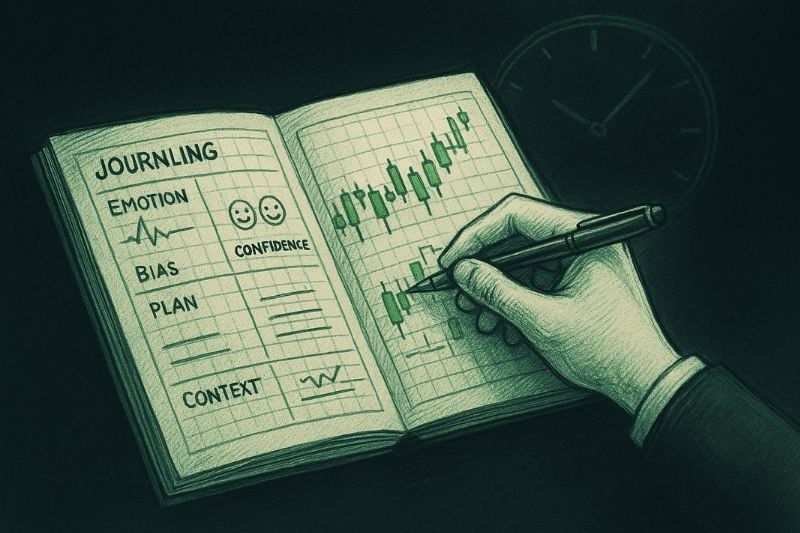
- Emotion tags: Fear, impulse, confidence, fatigue.
- Bias notes: Recency, confirmation, loss aversion.
- Plan adherence: Did you follow your strategy rules?
- Market context: Session, volatility, and structure.
Scoring System
Rate discipline instead of profit.
- 10/10: Perfect execution following plan.
- 7/10: Minor deviation.
- 5/10 or less: Major breach or emotional trading.
When reviewed weekly, this data shows where discipline slips and how risk management strategies can stabilize performance. Over time, you will start trading based on process rather than emotion, a defining habit of successful forex trading.
Weekly Review and Adjustment
Step back once a week to identify behavioral patterns.
- Do impulsive trades appear at specific hours?
- Does fatigue affect decisions near session close?
- Are losses larger after strong winning streaks?
From these insights, update your plan not only the technical trading strategy, but also the psychological rules. For example: “Avoid trading after three consecutive wins” or “Pause after midday if focus drops.” Journaling turns self-awareness into structure and process-driven growth.

Recovery Protocols After Losing Streaks
Every forex trading journey includes losing streaks. What separates professionals is how they respond. Emotional phases can distort rational thinking, increase stress, and lead to emotional trading.
Step Back Before Acting
When frustration builds, your ability to think clearly declines. Pause trading for 24–72 hours and reset your focus. Review your last ten trades without charts to identify recurring mistakes. This pause protects both your capital and your mindset, two pillars of solid risk management.
Identify Emotional Triggers
Losing streaks are often caused not by the system but by emotional responses to market volatility. Common triggers include:
- Fear of missing out → overtrading low-quality setups.
- Loss aversion → refusing to close bad trades.
- Recency bias → reducing size after one loss.
- Revenge trading → entering impulsively to win back losses.
Note these triggers in your trading journal and track them weekly. Awareness transforms reaction into data and control.
Rebuild Gradually
Avoid the temptation to win back losses quickly. Reduce position sizes and focus on execution.
| Phase | Objective | Risk per Trade | Things You May Do |
| Normal Trading | Strategy is performing well. Maintain consistency and confidence. | 0.5% | Continue following your trading plan, journal each trade, and track performance metrics. |
| Drawdown Period | Protect capital and manage emotions during a losing streak. | 0.25% | Reduce position size, take fewer trades, focus only on A+ setups, review strategy and execution, and avoid trying to recover losses quickly. |
| Recovery Phase | Rebuild gradually and regain rhythm after a drawdown. | 0.5% | Start small, maintain discipline, and focus on consistency before considering any increase in risk. |
This structure restores calm and improves trading performance while keeping your risk-reward ratio and risk tolerance consistent.
Reset Mind and Body
Mental fatigue affects decision quality as much as bad analysis. Prioritize rest, exercise, and hydration. Use short breathing sessions before the chart review. A clear mind is essential for consistent trading decisions.
Reflect, Learn, and Refine
Once composure returns, revisit your plan. Identify weak areas: patience, discipline, or analysis, and write one corrective rule, such as “Pause after three losses.” Successful traders understand that every losing phase is temporary, but lessons from it last a career.
Developing the Professional Trader Mindset
A professional mindset in forex trading is built through repetition and structure, not motivation. Trading psychology refers to how your mindset, habits, and behavior influence every trade. Professionals approach markets like engineers, using data and risk management strategies to control behavior and optimize decisions.
| Trait | Description | Benefit |
| Detachment from outcomes | Viewing each trade as one of many | Prevents emotional trading |
| Thinking in probabilities | Focusing on the edge, not the single results | Encourages disciplined risk management |
| Commitment to improvement | Tracking emotional and performance metrics | Builds stability under market volatility |
| Continuous learning | Adapting to changing market conditions | Keeps confidence grounded in skill |
Professionals rely on structured habits to sustain consistent trading performance. They refine their trading strategy, align their risk-reward ratio with their risk tolerance, and make decisions based on logic, not emotion.
Daily Mindset Practices
- Begin the day with a 5-minute focus reset.
- Use the affirmation: “Follow process, not results.”
- After each session, rate emotional control from 1 to 5.
- End the week by updating your journal summary.
These small rituals transform mindset management into a measurable habit, the foundation of successful trading.
Conclusion
Trading psychology is not about removing emotion but managing it with structure and awareness. In forex trading, real progress comes from journaling, reviewing, and applying disciplined risk management strategies.
Successful traders understand that consistency and rational thinking define long-term success. They learn from mistakes, adapt to market volatility, and make calm, focused trading decisions.
When structure guides behavior and patience shapes process, successful forex trading becomes the natural result of emotional control and disciplined execution.
Take your trading psychology to the next level with Top One Trader.Get funded with up to $500,000, enjoy a transparent rules set, fast payouts, and a supportive community built for serious traders. With advanced tools, learning resources, and flexible challenges, you’ll have everything you need to turn consistency into long-term success.
Home Trading Setup: Build a Pro Desk for Better Focus
Checked by the Top One Trader editorial team, experienced traders and analysts are committed to providing reliable, practical insights for funded trading success.
Ever wonder why some traders remain calm and precise even during volatile market swings? Often, it’s not just their strategy; it’s their environment. A professional Home Trading Setup helps traders maintain focus, comfort, and efficiency, which directly impacts performance.
In this guide, you’ll learn how to build your own setup with the right desk, monitor configuration, reliable hardware, stable internet, and tools that support your trading journey.
Quick Overview
A Home Trading Setup is the foundation of every successful trader’s workspace. By combining a comfortable desk, multiple monitors, powerful hardware, and a stable internet connection, you can trade with better focus, comfort, and speed. Building the right environment isn’t just about aesthetics; it directly impacts decision-making, execution, and consistency.
Trading Desk and Workspace
Trading Desk
Your trading desk is one of the most important aspects of your home trading setup. It should be large enough to support multiple monitors and sturdy enough to handle the weight of your trading computers, stands, and other essential trading tools.
Many traders invest in a standing desk or height-adjustable option to alternate positions during long hours of day trading. Changing your position helps reduce fatigue, maintain focus, and create a more productive trading space. Keeping monitors at eye level with a proper monitor arm also improves comfort and posture during market hours.
Trading Chair
An ergonomic chair is just as essential to a perfect trading desk setup as your computer or monitors. Whether you choose a gaming chair or a professional office model, the key is proper lumbar support that keeps your back and neck comfortable during long trading sessions.
Small details like adjustable recline, soft cushioning, and comfortable arm supports can make a big difference when you’re focused on your charts, news feeds, and market data for hours.
Trading Computers and Hardware
Desktop Computers
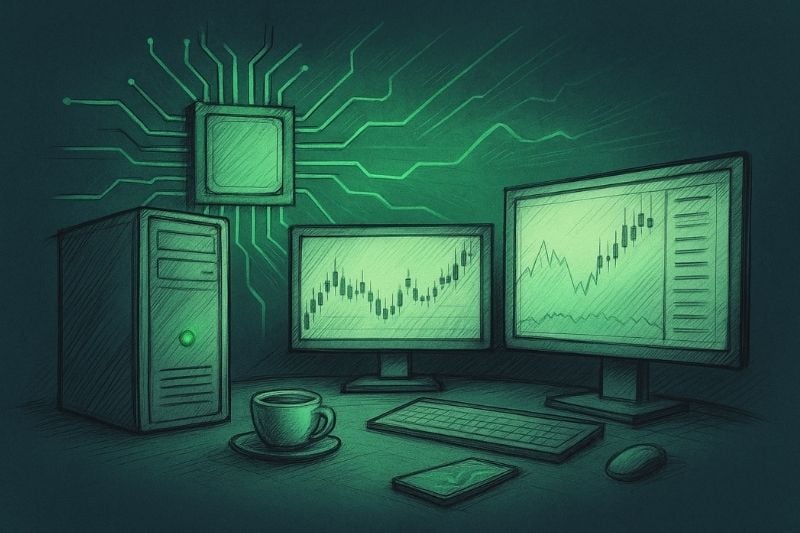
Desktops are the true power engines of trading. They deliver higher performance, better cooling, and far more upgrade flexibility than laptops, all crucial when you’re running several platforms, scanning multiple charts, and processing live data at once.
If you rely on algorithms or backtesting, a powerful desktop becomes essential. Handling large datasets and ensuring fast execution demand the extra CPU power, memory, and speed that only a desktop setup can provide.
Key specs to look for:
- Multi-core CPU for smooth multitasking.
- Dedicated GPU to handle multiple screens without lag.
- SSD for fast boot and quick data access.
- 16 to 32 GB of RAM is ideal, especially if you run heavy backtests or multiple trading programs at once.
- For the processor, an AMD Ryzen 7 (3700X or 6000 series) or an Intel i7 or i9 offers a great balance of power and efficiency.
If you’re into algorithmic trading or data-heavy analysis, consider upgrading your RAM and storage for smoother performance.
Recommended setups: an AMD Ryzen 7 (3700X or 6000 series) or Intel i7 or i9 is a solid starting point. Upgrade RAM and storage if you do algorithmic trading or data-heavy analysis.
Laptop for Trading
Not every trader wants to be tied to a desk. That’s where laptops come in. A laptop offers portability, making it easy to monitor trades on the go or use it as a backup when your main desktop isn’t available.
For trading, it’s best to avoid entry-level laptops. Instead, choose models that come with:
- A strong CPU and GPU to smoothly handle charts and multiple screens.
- Long battery life to keep your sessions uninterrupted.
- Fast SSD storage for quick, reliable platform performance.
The main advantage is flexibility; you can trade from your home office, a café, or even on the go without losing much power.
Quick tip: High-end options like the Dell XPS or MacBook Pro offer an ideal mix of performance and portability for active traders.
Monitor Setups for Trading
Your monitors are your window to the markets. A fast computer helps, but if you cannot see the right information at a glance, you still hesitate. Aim for a layout that shows charts, data and news without crowding the desk.
A large UHD monitor lets you park several charts or dashboards side by side. Many traders compare EUR/USD and GBP/USD in one view so they can spot small divergences and act a little quicker.
Example: LG 43″ UHD monitor.
Curved ultrawide monitors offer a panoramic sweep of price history. You see more candles in one glance, and the gentle curve often feels easier on the eyes during long sessions.
Example: Dell UltraSharp 49″ curved monitor.
A multi-monitor setup suits scalpers and day traders who track several markets and an order book at the same time. Two screens are enough for some people, while others feel comfortable with four or even six.
Horizontal screens can hold an economic calendar, a watchlist and the day’s headlines, leaving primary space for technical charts. It keeps you informed without clutter.
With a well-organized monitor setup, you notice context faster and decide with more confidence. That usually translates into cleaner entries and calmer trade management.
Ready to Take Your Trading to the Next Level? The right monitor setup gives you clarity, but real progress comes from skill, discipline, and support. Join Top One Trader to combine your setup with expert education, a strong community, and funded trading opportunities.
Internet and Connectivity
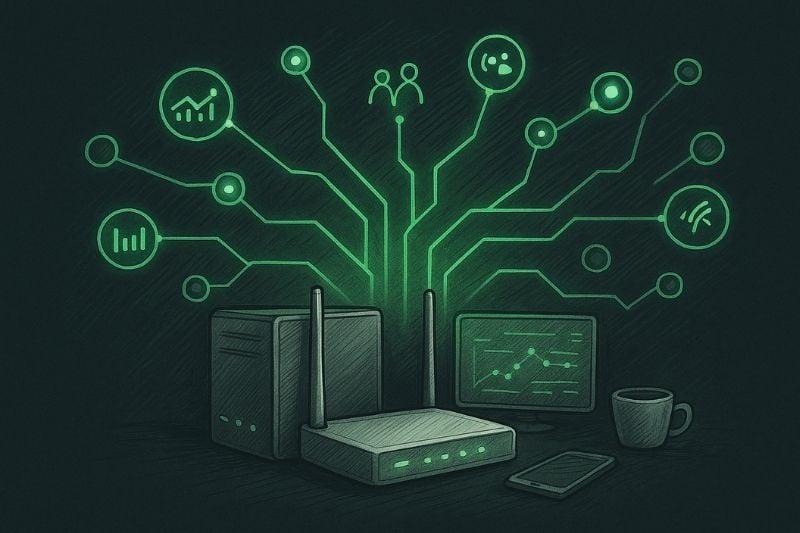
Nothing ruins a perfect setup like losing connection during a live trade. It is every trader’s nightmare. Even the best hardware means nothing without a fast, stable internet connection. A single lag spike or drop can cost real money, especially when you already have positions open and the market starts moving fast.
Aim for at least 100 Mbps high-speed internet, and always have a backup connection, such as a mobile hotspot or a second provider, in case of emergencies.
Connectivity also comes down to convenience. Power extensions and USB hubs make it easier to plug in multiple devices, charge accessories, and keep your desk organized. Combine that with good cable management, and your workspace stays clean and efficient.
The result is reliability. With the right internet setup and connectivity tools, you can execute trades smoothly, stay connected to the markets, and trade with confidence.
Trading Accessories
Once the core of your home trading setup is ready, the next step is fine-tuning it with accessories. These may seem secondary, but they often make the biggest difference in daily comfort and execution speed.
Input Devices
Your mouse and keyboard are the tools you touch the most during the day. An ergonomic design makes a huge difference when you are spending long hours in front of the screen. A regular office set can work, but gear made for professionals feels smoother, helps prevent wrist strain, and gives you better control.
It is a small change that pays off quickly. The easier it is to move around your trading platform, the more attention and energy you can give to real analysis and execution.
Trading Keypads
For traders who want to save every second, trading keypads are a powerful addition. Devices like the TradeMaster are designed with multiple programmable buttons for instant actions. Imagine being a scalper who needs to act fast. With a keypad, you can place a buy or sell, open stop or limit orders, set your lot size, and even place stop loss or take profit orders instantly.
Instead of scrolling through menus or clicking several times, the order is executed with a single tap. Some pads even allow you to preconfigure actions like 0.01, 0.05, 0.5, or 1 lot orders directly. This speeds up your workflow and helps avoid mistakes. The benefit is clear. Faster decisions, fewer errors, and smoother trade execution.
Monitor Supports and Cable Management
Once you start adding more screens and gear, things can get messy. That is when organization really matters. Monitor supports and adjustable arms help you move your screens to the perfect height so you can sit comfortably and avoid neck pain. They also clear some space on the desk, which always feels nice when everything else is fighting for room.
Cables, on the other hand, are the usual troublemakers. A bunch of tangled wires does not just look bad, it can mess with your focus. Simple tricks like using clips, trays, or built-in channels under the desk keep everything neat and out of sight. When the space around you looks clean and balanced, it is easier to think clearly and stay productive.
Software and Tools
Even the best hardware setup is incomplete without the right software. Trading is as much about the tools on your screen as it is about the equipment on your desk.
Trading Platforms
Most traders rely on platforms such as MetaTrader 4 (MT4), MetaTrader 5 (MT5), Trade Locker and TradingView, along with broker or prop firm platforms. These are the gateways to the markets. MT4, MT5, and Trade Locker are excellent choices for executing trades, offering speed, stability, and advanced order management tools.
TradingView, on the other hand, is one of the best platforms for charting and technical analysis, thanks to its clean interface and wide range of indicators. Choosing the right platform depends on your trading style. For example, if you are a scalper, you need an advanced platform for fast order execution.
News Feeds and Economic Calendars
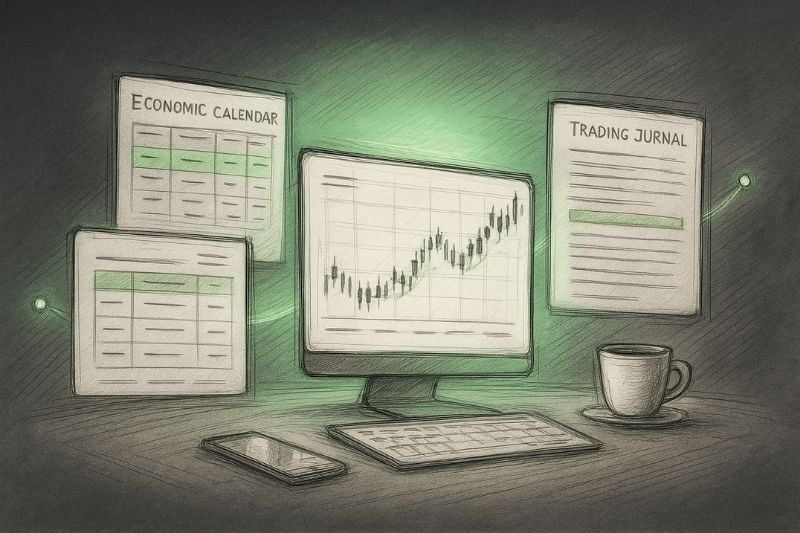
Charts tell part of the story, but the real moves often start with the news. A sudden rate decision, a jobs report, or a policy comment can shift the entire market in seconds. That’s why experienced traders keep one eye on their charts and the other on economic calendars.
Platforms such as MyFXBook, Forex Factory, or Investing.com make it easy to follow key events and data releases in real time. When you know what’s on the schedule, you’re better prepared to handle market volatility, plan your entries, and protect your trades before the market reacts.
Dashboards and Trading Journals
To trade like a professional, you need to analyze more than just price action. You must also analyze your own performance. Dashboards and trading journals are powerful tools for tracking metrics such as win rate, profit and loss, risk-to-reward ratios, and consistency over time.
Integrating dashboards with your trading journal lets you visualize your data clearly, helping you identify strengths, weaknesses, and behavioral patterns that affect results. Over time, this data-driven feedback loop becomes one of your biggest advantages in improving as a trader.
Position Size Calculators
Position size calculators ensure every trade aligns with your risk management plan. They help you calculate the correct lot size based on your account balance, stop loss distance, and risk percentage per trade. Using them consistently keeps your exposure under control and protects your capital from unnecessary losses.
Conclusion
A good trading setup is more than screens and hardware. It is the space where focus meets discipline. When everything around you works smoothly, your mind follows. But don’t forget, the real progress comes from learning and building your skills. Combine both, and you will start to see great results in your trading.
Start Building Your Trading Future. Your home trading setup is the first step toward professional success. Combine the right environment with skill, discipline, and support from Top One Trader to unlock your full potential.
Join today and trade with confidence, focus, and funding behind you.